Most people walk into a gym expecting a simple choice – pick a weight, start lifting. Then they see rubber hex dumbbells, urethane dumbbells, pro-style dumbbells, selectorized adjustables, neoprene options, and about ten more variations nobody warned them about.
This guide covers different types of dumbbells with honest pros and cons for each. By the end, you will know exactly which type fits your training style, space, and budget.
What Is a Dumbbell and Why Does the Type Matter?
A dumbbell is a short, handheld weight with resistance on both ends of a central handle. The word “dumb” comes from old English, where it meant silent — these weights do not clang like a bell. Athletes have trained with hand-held weights since ancient Greece, where stone and iron halteres served a similar function.
The type of dumbbell matters more than most people realize. Shape affects whether it rolls off the floor mid-set. Material determines durability, noise, and floor safety. The adjustment system decides how quickly you can switch weights. A mismatched purchase leads to wasted money, cluttered space, or equipment that does not survive its first year.
The Two Core Categories
Every dumbbell falls into one of two structural categories.
Fixed dumbbells have a permanent, non-changeable weight. They are grab-and-go — no setup, no adjustment, no moving parts. Most gyms stock them in graduated sets from very light to very heavy.
Adjustable dumbbells allow the user to change the resistance. Some use screw-on collars and individual plates. Others use dial mechanisms or sliding pins. The tradeoff is setup time versus storage efficiency.
Every variation described below belongs to one of these two categories.
The Different Types of Dumbbells Explained
1. Rubber Hex Dumbbells
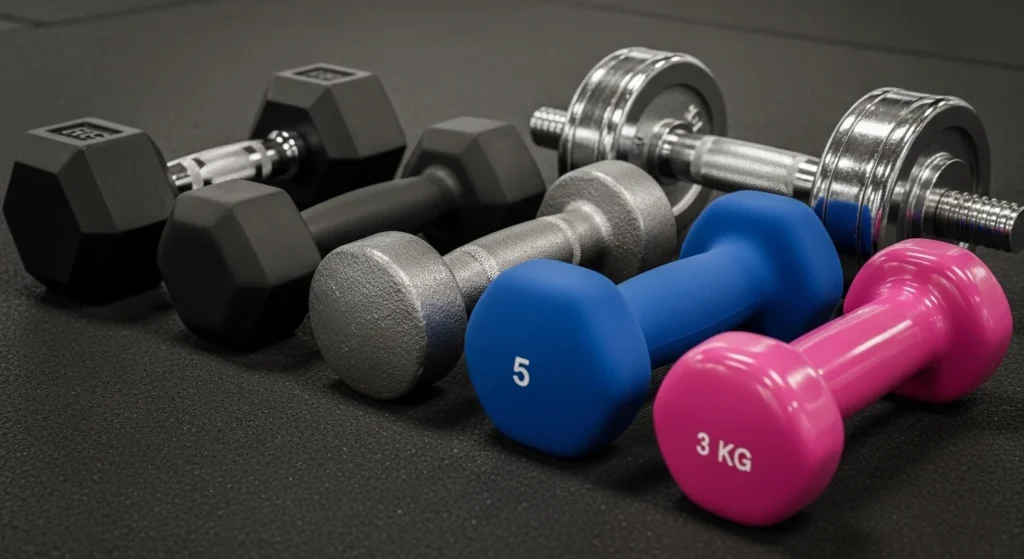
Rubber hex dumbbells are the most common type found in both home and commercial settings. The bell ends have six flat sides, and a rubber coating covers the weight heads. The handle is typically knurled chrome or steel.
The hex shape is the primary functional advantage. It prevents rolling when the dumbbell is placed on the floor — critical for exercises like renegade rows, push-ups, and any floor movement requiring a stable base. You can also stack them to conserve space without a rack.
Pros:
- Will not roll on flat surfaces
- Rubber coating protects flooring and absorbs impact noise
- Most affordable heavy-duty fixed option
- Available from 5 lbs to 120+ lbs
- Suitable for beginners through advanced lifters
Cons:
- Cheap recycled-rubber models carry a strong factory odor
- Hex edges can press uncomfortably into the thighs during press setup
- Contoured (rather than fully knurled) handles are preferred by some, not others
- UV exposure degrades the rubber — keep these indoors
Best for: Home gym owners, CrossFit athletes, commercial gyms on a moderate budget, and anyone prioritizing floor safety.
2. Urethane Dumbbells (Round or 12-Sided)
Urethane sits chemically between rubber and plastic — impact-resistant, pliable, and exceptionally durable. High-end commercial facilities stock urethane dumbbells because they survive constant use, drops, and daily disinfectant cleanings without cracking, chipping, or peeling.
Two shapes dominate this category. Round urethane dumbbells have a circular bell that feels smooth against the thigh during press setups. The 12-sided variant has enough flat faces to prevent rolling while remaining more comfortable than a sharp hex edge.
Pros:
- Completely odorless — no rubber factory smell
- Resistant to cracking, peeling, and abrasion under heavy commercial use
- Will not mark floors when dropped
- Available from 5 lbs to 150 lbs
- Easy to clean with standard disinfectants
- Retains appearance for years under daily use
Cons:
- Most expensive fixed dumbbell option
- Round heads roll freely on flat surfaces
- High upfront cost is difficult to justify for casual training
Best for: New commercial gyms, boutique fitness studios, and serious home gym owners who want equipment that lasts indefinitely.
3. Cast Iron Dumbbells
Cast iron dumbbells are the oldest design still in widespread use. They are a single cast metal piece — no coating, no rubber, just iron, sometimes with a basic oxide or enamel finish to slow rust.
These are honest, no-frills weights. No coatings degrade, no rubber cracks, no moving parts fail. The tradeoff is vulnerability to rust in humid storage conditions and a complete lack of floor protection.
Pros:
- Very affordable, especially from secondhand markets
- Durable base construction with nothing to wear down
- Classic feel preferred by many experienced lifters
- Widely available
Cons:
- Rust without regular oiling or dry storage conditions
- No floor protection — will damage surfaces if dropped without mats
- Loud on impact
- Require rubber matting underneath at all times
Best for: Budget home gym setups with existing rubber matting, and lifters who prefer the traditional iron feel.
4. Chrome Dumbbells
Chrome dumbbells have a mirror-like polished finish that stands out immediately. A chrome plating layer covers the steel or iron construction, providing light corrosion resistance and a polished aesthetic.
The finish looks sharp in a home gym or light-use studio. The practical problem is that chrome becomes slippery under sweaty hands, and these dumbbells are generally not built to be dropped repeatedly.
Pros:
- Genuinely attractive in a polished gym setting
- Chrome finish resists light corrosion better than bare iron
- Knurled handles grip well under dry conditions
- Compact heads store easily
Cons:
- Usually capped around 50 lbs — limiting for strength-focused training
- Slippery surface when sweaty unless the knurling is very aggressive
- Chrome plating chips and wears over time
- Round heads roll freely
- Not significantly cheaper than better alternatives
Best for: Small studios running light aerobic classes, home gym owners who prioritize aesthetics, and anyone training in the 5–40 lb range.
5. Neoprene Dumbbells
Neoprene dumbbells are the soft, colorful weights found in group fitness classes, physical therapy clinics, and beginner workout setups. A foam neoprene coating covers the metal core, and the hex shape prevents rolling.
The coating provides a non-slip texture that stays effective with sweaty hands. These are also some of the quietest dumbbells available, and they are easy to disinfect between class participants.
Pros:
- Comfortable to hold during extended high-rep training
- Non-slip surface works well without gloves
- Will not damage floors or create excessive impact noise
- Hex shape prevents rolling
- Easy to clean
- Budget-friendly for the light-weight range
Cons:
- Not available above 20–25 lbs
- Neoprene tears and cracks with heavy daily use
- Unsuitable for serious strength training or significant progressive overload
- Cannot be dropped without damaging the coating
Best for: Beginners, injury rehabilitation, prenatal fitness, older adults, and group aerobics classes.
6. Vinyl Dumbbells
Vinyl dumbbells look similar to neoprene at first glance but use a harder, glossier plastic-based coating rather than foam. They are typically the cheapest dumbbell option available and are easy to wipe down between uses.
The surface is more durable against cleaning chemicals than neoprene but cracks more readily under physical stress. The smooth coating can also be slippery when hands are sweaty.
Pros:
- Lowest cost option for light resistance training
- Very easy to clean and disinfect
- Hex shape prevents rolling
- Protect floors from scuffing
Cons:
- Vinyl cracks and peels with regular use, often requiring replacement within a year
- Not available above 15–20 lbs
- Slippery when sweaty
- Not suitable for serious training
Best for: Casual home users, beginners starting very light, and low-budget setups needing one or two pairs.
7. Pro-Style Dumbbells
Pro-style dumbbells look different from everything else on this list. Instead of cast or molded heads, they are assembled from individual weight plates bolted or welded onto a central handle — structurally similar to a short barbell. The handles are typically shorter and more uniform in diameter than other dumbbell types.
These are common in older commercial gyms and traditional bodybuilding facilities. Some pro-style heads come encased in virgin rubber; others are bare metal with a chrome or hammer-tone coating.
Pros:
- Highly durable — plate-based construction means individual heads can sometimes be replaced without buying a whole new dumbbell
- Shorter handles reduce wrist strain during pressing movements
- Professional, classic appearance in traditional gym settings
- Plates sit uniformly on storage racks, taking up less space than hex dumbbells
Cons:
- Round heads roll freely
- More expensive than hex dumbbells of equivalent weight
- Not stable for floor-based exercises
Best for: Commercial gyms maintaining a traditional bodybuilding aesthetic and experienced lifters who prefer classic construction.
8. Selectorized (Dial-Adjust) Adjustable Dumbbells
Selectorized dumbbells are what most people picture when they hear “adjustable dumbbells.” A dial at one or both ends selects a specific weight, and unused plates remain in the base cradle when you lift the handle. One pair can cover a range from 5 lbs to 90 lbs depending on the model.
Note: As of mid-2025, Bowflex recalled the SelectTech 552 and 1090 models due to plates dislodging during use. Verify recall status before purchasing any selectorized model secondhand.
Pros:
- One pair replaces 10–15 sets of fixed dumbbells
- Weight changes in seconds
- Excellent for progressive overload in a compact home gym setup
- Base cradle serves as built-in storage
Cons:
- High upfront cost
- Mechanical parts can wear or fail over time
- Bulkier profile than a standard dumbbell of equivalent weight
- Dropping them damages the adjustment mechanism
Best for: Home gym owners with limited space who want a wide weight range, apartment lifters, and beginners building strength progressively.
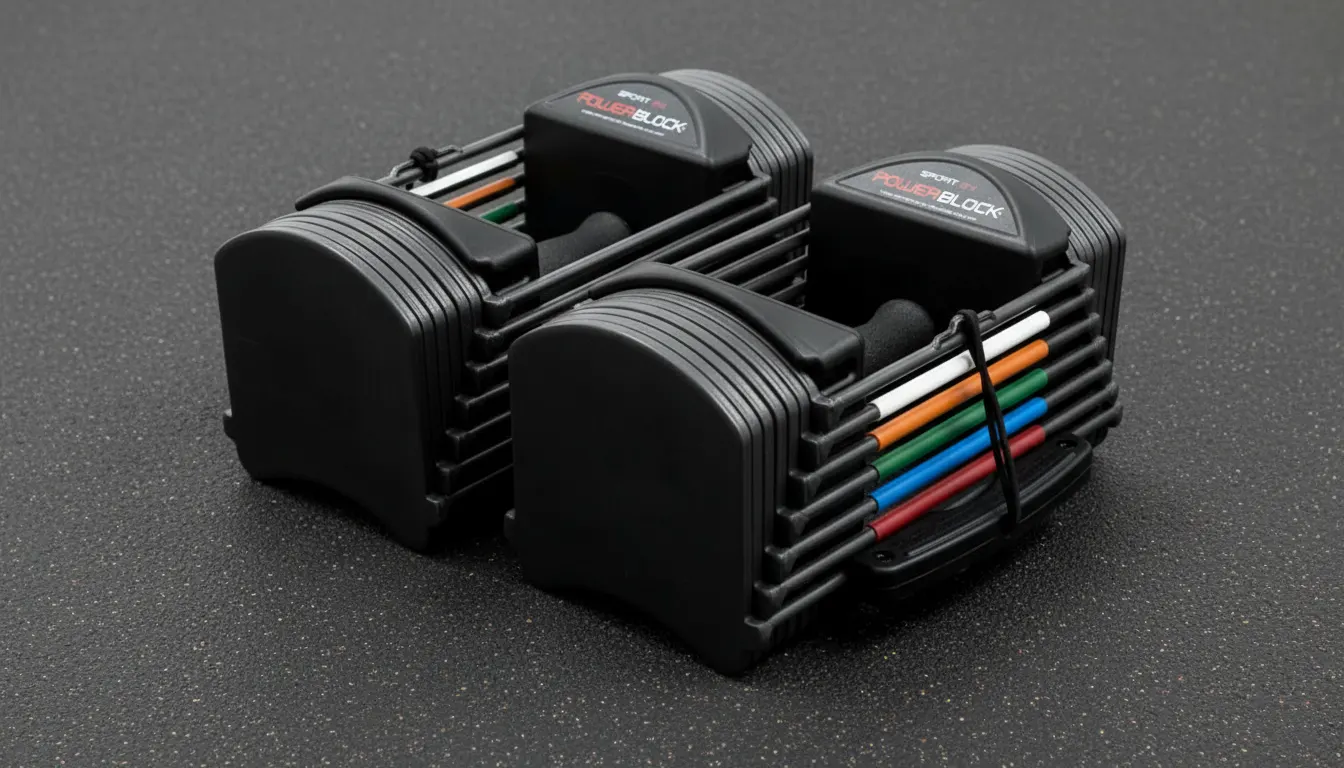
9. Pin-Lock (PowerBlock-Style) Adjustable Dumbbells
Pin-lock adjustable dumbbells use a sliding pin that inserts into a selector position on a nested cage design. Plates surround the handle in a square or rectangular block, and the pin determines how many you lift. The profile looks nothing like a traditional dumbbell — it is boxy — but adjustment speed is fast and the weight range is wide.
Pros:
- Very fast weight changes
- Compact footprint for the range offered
- Expansion kits available for progressive weight increases
- Generally more durable than dial-based systems
Cons:
- Boxy shape is awkward for some exercises, particularly neutral-grip presses
- Wider profile at heavier settings can interfere with arm position
- More expensive than basic plate-loaded handles
- The cage design collects sweat and dust
Best for: Home gym users needing fast weight changes during circuit training or HIIT, and lifters who need a heavy weight range in minimal floor space.
10. Spin-Lock (Plate-Loaded) Adjustable Dumbbells
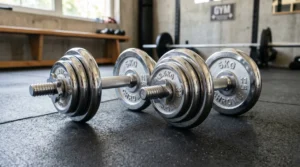
Spin-lock dumbbells are the most manual adjustable option. A threaded collar screws closed to secure standard weight plates on the handle. The principle is identical to a standard barbell, but on a much shorter handle.
These are the most affordable entry into adjustable training — handles are available for as little as $10–20 used and $50–75 new. The tradeoff is setup time. Switching from a warmup weight to a working weight means removing collars, swapping plates, and retightening on both sides of both dumbbells.
Pros:
- Lowest cost adjustable option, especially when combined with plates you already own
- No moving parts to fail
- Can be loaded to very heavy weights
- Standard 1-inch handles work with most home plate sets
Cons:
- Slow to adjust — impractical for circuits or supersets
- Loose collars are a safety hazard if not checked before every set
- 2-inch Olympic handles are more versatile but add cost
- Not appropriate for commercial or shared gym environments
Best for: Budget home gym builders who already own plates, garage gym setups, and anyone who trains at a deliberate pace with long rest periods.
11. Loadable (Handle-Only) Dumbbells
Loadable dumbbell handles are essentially miniature barbells. You load individual weight plates and secure them with collars — the difference from spin-lock is primarily the handle quality and the collar system, which tends to be faster to secure and more reliable under load.
Ironmaster and similar brands built followings around this design. A 10 lb loadable dumbbell looks and feels like a real 10 lb dumbbell rather than a cage with attached plates. Weight progression is granular — small plate increments allow very precise loading.
Pros:
- Traditional dumbbell feel at any weight
- Faster and more secure than spin-lock systems
- Compatible with existing Olympic plate collections
- Very precise weight progression with small increments
- No electronic components to fail
Cons:
- Still requires plate changes between exercises
- Collars must be checked before every set
- Bumper plates are incompatible — their large diameter makes them unusable here
- Not efficient in high-volume commercial settings
Best for: Serious home gym lifters who train heavy and do not need to switch weights frequently mid-session.
12. Studio Dumbbells
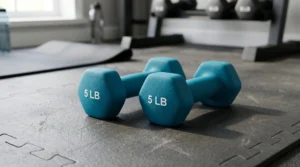
Studio dumbbells are light, fixed-weight dumbbells designed for group fitness classes — yoga with weights, barre, Pilates, and aerobics formats. They typically fall between 1 and 15 lbs and are often color-coded by weight for quick identification. Most are neoprene or vinyl coated, though “studio dumbbell” refers to the intended use context rather than a specific material.
Pros:
- Color coding allows instant weight identification during fast-paced classes
- Comfortable for extended high-rep training
- Easy to disinfect in shared environments
- Non-damaging to floors
Cons:
- Limited to very light weights — no path for significant strength development
- Cannot be used effectively for compound strength movements
- Not cost-effective for progressive strength training
Best for: Group fitness studios, yoga and Pilates facilities, physical therapy clinics, and light aerobic home workouts.
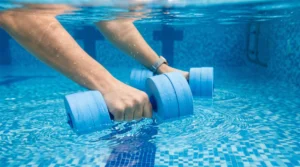
13. Aqua (Water) Dumbbells
Aqua dumbbells are made from foam or lightweight buoyant materials specifically for water-based resistance training. Underwater, pushing or pulling the buoyant handles against the water creates resistance — intensity scales with movement speed and water depth.
These are most common in aquatic physical therapy, senior fitness programs, and prenatal exercise classes held in pools.
Pros:
- Zero impact on joints — water provides full cushioning
- Resistance scales naturally with movement speed
- Appropriate for arthritis, injury recovery, and limited-mobility populations
Cons:
- Completely useless outside of a water environment
- Cannot produce progressive overload for muscle hypertrophy
- Not practical for standard home or commercial gym setups
Best for: Aquatic therapy, senior fitness programming, rehabilitation clinics, and prenatal pool exercise classes.
14. Smart Dumbbells
Smart dumbbells incorporate built-in sensors, accelerometers, and Bluetooth connectivity to track reps, sets, range of motion, tempo, and sometimes caloric expenditure. Some models integrate digital weight adjustment — a dial or motorized mechanism changes the resistance while an app logs every set.
Pros:
- Automatic tracking eliminates manual logging
- App integration enables structured programming and progress visualization
- Weight adjustment systems replace entire dumbbell sets in a compact footprint
- Data on rep tempo and range of motion can flag technical inconsistencies
Cons:
- Significantly more expensive than any traditional dumbbell type
- Require charging or battery replacement
- App dependency — discontinued software renders tracking features unusable
- Sensor housing adds bulk and can feel awkward compared to traditional handles
Best for: Tech-forward home gym users, lifters who struggle with self-tracking, and people building fully connected home training setups.
15. Stainless Steel Dumbbells
Stainless steel dumbbells use a rust-resistant alloy throughout the construction rather than applying a coating to a cast iron core. This eliminates coatings entirely — the steel is the finished product.
These are rarer than other types but appear in high-end commercial facilities and minimal-aesthetic home gyms.
Pros:
- Rust-resistant without any coating
- No coating to peel, crack, or degrade
- Clean, minimal appearance
- Very long service life
Cons:
- Damaging to flooring without thick rubber mats
- Loud when dropped on hard surfaces
- Among the most expensive fixed options
- Limited availability compared to rubber or urethane types
Best for: Premium commercial facilities, high-end home gym builds, and lifters who want coating-free equipment with a minimalist look.
All 15 Dumbbell Types at a Glance
| Type | Weight Range | Best For | Floor Safe? | Adjustable? | Cost |
| Rubber Hex | 5–120+ lbs | Home/commercial | Yes | No | Low–Mid |
| Urethane | 5–150 lbs | Commercial gyms | Yes | No | High |
| Cast Iron | 5–120+ lbs | Budget training | No | No | Low |
| Chrome | 3–50 lbs | Light training | No | No | Mid |
| Neoprene | 1–25 lbs | Classes/rehab | Yes | No | Low |
| Vinyl | 1–20 lbs | Casual use | Yes | No | Very Low |
| Pro-Style | 5–150 lbs | Commercial/traditional | No | No | Mid–High |
| Selectorized | 5–90 lbs | Space-saving home gym | No | Yes | High |
| Pin-Lock | 5–130+ lbs | Home circuits | No | Yes | High |
| Spin-Lock | Variable | Budget adjustable | No | Yes | Very Low |
| Loadable | Variable | Heavy home training | No | Yes | Low–Mid |
| Studio | 1–15 lbs | Group classes | Yes | No | Low |
| Aqua | N/A | Pool therapy | N/A | No | Low |
| Smart | Variable | Tech-integrated training | No | Some | Very High |
| Stainless Steel | 5–120+ lbs | Premium setups | No | No | High |
How to Choose the Right Type for Your Training
Match the Environment First
Commercial gyms with hundreds of daily users need urethane or rubber hex dumbbells that can absorb constant drops and disinfectant cleanings. A home gym in a carpeted spare room has different requirements entirely — a set of spin-lock handles and an existing plate collection may be sufficient for years.
Weight Range vs. Training Goal
Strength training for hypertrophy or power requires access to progressively heavier weights. If your programming calls for 80 lb dumbbell rows, neoprene or chrome options will never get you there. Selectorized or loadable adjustable dumbbells provide a wide range in a single footprint. A full rack of rubber hex dumbbells covers the range if you have space and budget.
Floor and Noise Considerations
Rubber and urethane coatings significantly reduce floor damage and noise on drops. Apartment lifters and anyone training below living spaces should prioritize coated dumbbells. Bare cast iron and stainless steel require thick rubber gym mats at all times.
Long-Term Cost vs. Upfront Price
The cheapest dumbbell is not always the most economical. Vinyl dumbbells at $15 per pair that require replacement every year cost more over a decade than rubber hex dumbbells purchased once. Urethane dumbbells cost significantly more upfront but rarely need replacement even under commercial conditions.
Frequently Asked Questions (FAQs)
What is the best type of dumbbell for a home gym?
For most home gym users, rubber hex dumbbells offer the best mix of durability, floor protection, stability, and cost. If space is the primary constraint, a quality selectorized adjustable set replaces an entire rack without taking up more floor space than a single fixed pair.
Are adjustable dumbbells worth the cost?
Yes, for most home gym lifters. A quality adjustable set covers a 5–90 lb range in the footprint of one or two fixed pairs. The cost per pound of weight range is lower than buying multiple fixed pairs, and the weight progression scales with your strength.
What is the difference between rubber and urethane dumbbells?
Rubber is softer, more affordable, and more prone to odor. Urethane is harder, more expensive, odorless, and more resistant to abrasion over years of use. For commercial facilities, urethane is the clear long-term choice. For home gyms, rubber performs very well at lower cost.
Why do gym dumbbells have hex shapes?
The hexagonal shape prevents the dumbbell from rolling when placed on the floor — important for renegade rows, push-ups, and any floor-based movement requiring a stable weight. Round dumbbells roll freely, creating safety risks and disruption during floor work.
Can I use spin-lock dumbbells for heavy lifting?
Yes, provided the collars are properly tightened before every set. Loose collars under load can allow plates to shift mid-lift. Check both collars on both dumbbells before beginning any set, without exception when lifting heavy.
Are neoprene dumbbells good for strength training?
Neoprene dumbbells are appropriate for light high-rep training and aerobic-style workouts. Their weight ceiling — usually 20–25 lbs — limits usefulness for progressive strength training. Anyone programming loads above 25 lbs needs a different type.
What dumbbells do professional commercial gyms typically use?
Most modern commercial facilities use urethane dumbbells in round or 12-sided configurations for their durability and low maintenance requirements. Older or traditional-style gyms often stock pro-style dumbbells for their classic construction and appearance.
Do smart dumbbells actually track workouts accurately?
Accelerometers in smart dumbbells accurately count reps and detect basic range of motion. Where they struggle is auto-identifying specific exercise types and tracking complex movement patterns. They work best as a convenient logging tool for straightforward exercises rather than a precise biomechanical analysis system.
What is the typical lifespan of rubber hex dumbbells?
Quality rubber hex dumbbells from reputable manufacturers last 10 to 15 years under regular home use. Commercial settings see faster wear but still expect five or more years from good rubber construction. Degradation accelerates when stored in direct sunlight or repeatedly cleaned with aggressive chemical solvents.
Should beginners start with adjustable or fixed dumbbells?
Both work for beginners. Fixed dumbbells are simpler — grab the weight and go. Adjustable sets require slight familiarity with the mechanism but save money and space for anyone who plans to train consistently and increase weights over time.
In conclusion
There is no universally best dumbbell. Rubber hex dumbbells work well for most home and commercial settings. Urethane is the right call for facilities that need equipment to survive years of daily heavy use. Adjustable designs in any form answer the question when space is the primary constraint. Specialty types like aqua dumbbells and smart dumbbells serve specific purposes that standard weights cannot fill.
Match the dumbbell type to where you train, how you train, how often you train, and what you can realistically spend. Get that match right and the equipment stops being a factor — you just lift.
Want to strengthen your hamstrings, glutes, and lower back? Check out How To Do Dumbbell Good Mornings for proper form, key benefits, and tips to perform this hinge movement safely and effectively.