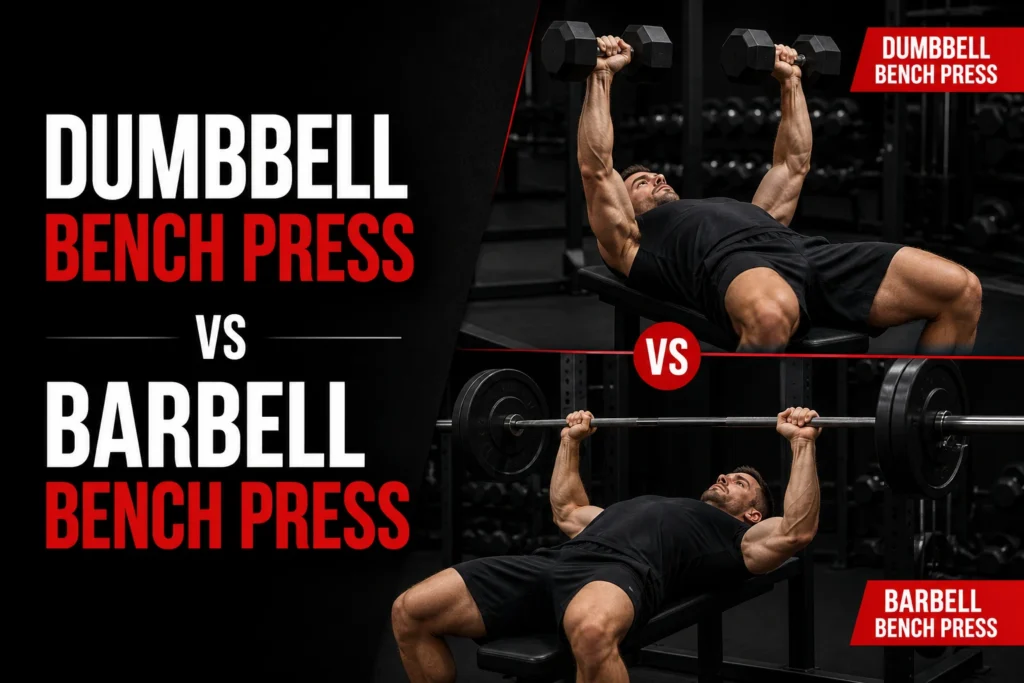
If you train chest with any regularity, you have asked this question a hundred times: dumbbells or barbell?
The answer matters more than most people realize. These two exercises look nearly identical from across the gym. Same bench, same basic motion, same muscle groups. But the differences in how they load your joints, activate your pecs, and respond to long-term programming are significant enough to change what your chest looks like and how your shoulders feel five years from now.
What the Research Actually Says About Muscle Activation
Start with the science, because a lot of the gym-floor mythology around this debate does not hold up.
A widely cited 2017 study found that the dumbbell bench press produced greater activation of the pectoralis major and biceps brachii compared to the barbell version. The barbell, on the other hand, showed higher triceps brachii activation. A separate study published in PMC examined 17 resistance-trained men and found that barbell bench press produced higher overall activation of the pec major, anterior deltoids, and triceps across most phases of the lift — but this was against dumbbell flyes, not a direct dumbbell press comparison.
The practical takeaway from both studies: neither exercise crushes the other across the board. They distribute work differently, and that difference is worth understanding rather than dismissing.
Why Dumbbells Activate the Pecs Differently
The core reason comes down to range of motion and what happens at the bottom of the rep.
With a barbell, the bar physically contacts your chest and stops the descent there. With dumbbells, your hands can travel below your torso, creating a longer eccentric stretch through the pectoral fibers. Research on muscle hypertrophy consistently shows that training a muscle through a full range of motion — especially under load at longer muscle lengths — produces greater growth stimulus.
At the top of the dumbbell press, you can also bring the weights toward each other, creating a squeeze and short contraction that a barbell grip simply cannot replicate because both hands are locked in position.
Why the Barbell Still Has a Case for Chest Development
The barbell concentrates force at the mid-range and at lockout. Because you can load it significantly heavier — most lifters move 20 to 30 percent more on a barbell than with dumbbells — the absolute mechanical tension on the chest is high even if the range of motion is shorter.
High mechanical tension is one of the primary drivers of hypertrophy. So while the dumbbell might win on range of motion, the barbell can compensate with raw load. The optimal solution, which most experienced coaches arrive at, is to use both.
Biomechanics: How Each Exercise Actually Moves
Barbell Bench Press Movement Pattern
The barbell fixes your hands in a locked, parallel relationship. Your elbows must track within that constraint, which narrows the natural movement arc your shoulder joint wants to follow. Grip width affects this significantly: a 2024 study published in Frontiers in Physiology found that narrower grip widths reduced acromioclavicular compression and decreased glenohumeral posterior shear forces compared to wide grips. Scapular retraction produced similar protective effects.
In practical terms, the barbell forces a more structured, repeatable bar path. That repeatability is useful for building maximal strength because your neuromuscular system learns the exact groove. It is also what makes the barbell the standard for powerlifting competition and strength benchmarks.
Dumbbell Bench Press Movement Pattern
Dumbbells allow each arm to move along its own natural arc. Your wrists can rotate, your elbows can flare or tuck to whatever angle feels right for your anatomy, and both sides operate independently. That independence is the defining feature of the dumbbell press — both its advantage and its limitation.
The advantage is joint-friendliness. Lifters with shoulder impingement or AC joint issues often find that dumbbells let them press pain-free at angles the barbell cannot accommodate. The limitation is stability demand. Because each dumbbell must be controlled independently, the rotator cuff, serratus anterior, and smaller shoulder stabilizers work significantly harder, and this reduces how much total load you can manage.
Muscles Worked
Primary Muscles (Both Exercises)
The pectoralis major is the main driver in both movements. It performs horizontal adduction — the action of bringing your upper arm across your body — which is what pressing does in the horizontal plane. The anterior deltoid assists the pec major throughout the press and picks up more of the load as fatigue sets in. The triceps brachii extends the elbow to lock out the rep at the top.
Secondary Muscles: Where They Diverge
The dumbbell bench press demands more from the rotator cuff muscles — particularly the infraspinatus and subscapularis — because each arm must maintain its own path without the structural anchor of a bar. The serratus anterior, which protracts the scapula and is critical for shoulder health, works harder in the dumbbell variation. The biceps brachii shows measurably higher activation with dumbbells, likely because it helps decelerate and control the independent loads during the eccentric.
The barbell bench press, by contrast, shifts more demand to the triceps, particularly at lockout, where the straight-bar path requires full elbow extension against a heavier absolute load. The upper back and lats engage isometrically to provide the stable pressing platform — something you feel acutely when you stop retracting your shoulder blades mid-set.
Range of Motion: The Detail That Changes Everything
This is where the dumbbell bench press earns its reputation for chest hypertrophy.
When you lower dumbbells with good technique, the handles can drop several inches below the level of your chest, stretching the pectoral fibers under load. That stretched-under-tension stimulus is highly effective for muscle growth. Some lifters with long arms and mobile shoulders achieve a stretch comparable to a dumbbell fly at the bottom of their press, then drive back up into a full press pattern. That combination in a single rep is difficult to replicate with any barbell variation.
At the top of the barbell press, your arms reach lockout and that is the rep. At the top of the dumbbell press, you have the option to bring the weights closer together, squeeze the pecs harder, and hold that contracted position. Neither action is magic on its own, but over thousands of reps across months of training, more contraction and more stretch add up.
Strength and Progressive Overload
The Barbell’s Advantage for Getting Stronger
If your goal is to move the most weight possible, the barbell wins without much argument. You can load a barbell in small increments — fractional plates of 1.25 lb are common — making weekly progress in the 2.5 to 5 lb range achievable for beginners and intermediate lifters. This systematic loading is a core principle of strength programming.
Dumbbells typically increase in 5 lb jumps per hand, which means a 10 lb total increase in each step. Going from 60 lb dumbbells to 65 lb is a 16 percent jump in load per hand. Expecting the same rep performance at that new weight is unrealistic. This incremental problem does not make dumbbells bad for getting stronger — it just means your progression strategy needs to adjust.
Progressive Overload Strategies for Dumbbell Bench Press
The lifters who stall on dumbbell presses are almost always adding weight before they are actually ready, or treating the dumbbell press exactly like they would treat a barbell.
Better approaches exist. Rather than jumping to the next dumbbell weight the moment the current weight feels manageable, build your rep capacity first. If you press 60 lb dumbbells for three sets of eight, work up to three sets of twelve with controlled form before moving to 65s. The rep expansion gives your stabilizers time to adapt to the load, which makes the heavier pair feel much more manageable when you get there.
Tempo manipulation is another tool that works particularly well with dumbbells. A three-second eccentric on a 60 lb dumbbell press creates more mechanical tension than a fast-drop set with 65s. Slow the descent, pause briefly at the bottom to eliminate momentum, and press with intent. This approach lets you keep progressing when weight jumps are too large.
Other effective overload methods for the dumbbell bench press include: reducing rest periods gradually, adding sets before adding weight, incorporating paused reps at the bottom position, and using the range-of-motion advantage by actively controlling the stretch at the bottom rather than just touching the handles to your chest.
Safety and Shoulder Health
Where the Barbell Gets Complicated
The barbell bench press is involved in more acute training injuries than almost any other gym exercise. The fixed bar path means that if the movement pattern does not suit your shoulder anatomy, you cannot adjust it — you just keep loading the same problematic position. Shoulder impingement, AC joint stress, and rotator cuff strain are all associated with barbell pressing, particularly with wide grip, high elbows, and heavy loading.
The 2024 Frontiers in Physiology study found that grip width and scapula position significantly affected shoulder joint loads. Narrower grips and proper scapular retraction reduced stress on both the acromioclavicular and glenohumeral joints. These are adjustable technique variables, but many lifters simply add weight without addressing them.
Where Dumbbells Are More Forgiving and Where They Are Not
For lifters with anterior shoulder instability or existing rotator cuff problems, physical therapists often recommend starting with dumbbells rather than the barbell. The ability to adjust your hand path and wrist angle mid-rep means you can press around pain rather than through it, which is relevant during rehab progressions.
That said, the higher stabilizer demand of dumbbells is a double-edged factor. A healthy shoulder builds resilience through stabilizer work. An already-compromised shoulder may fatigue those stabilizers and worsen instability if you load too heavy too soon. Starting light and controlling the eccentric carefully is particularly important for the dumbbell variation when shoulder health is a concern.
The other safety consideration is getting into position. Getting heavy dumbbells into starting position without a spotter requires a technique — the knee-kick or thigh-assist method — that itself carries injury risk if done sloppily. Failing on a heavy barbell rep with safety bars in place is often safer than failing with 100 lb dumbbells and nowhere to put them.
Correcting Muscle Imbalances
This is where the dumbbell bench press has a clear, practical edge that the barbell cannot match.
With a barbell, your dominant side compensates for your weaker side without either you or the bar noticing. The strong arm does slightly more work on every rep, the pattern repeats over months, and the imbalance either stays the same or gets worse. You can try addressing this with single-arm exercises, but the primary pressing movement continues to mask the gap.
With dumbbells, each side has to produce its own force to complete the rep. If your left pec is meaningfully weaker than your right, you will notice it almost immediately — the left dumbbell moves slower, stops shorter, or fails first. This feedback is uncomfortable but useful. Over time, the weaker side is forced to develop in order to match the stronger one rather than being carried along by it.
For anyone returning from a unilateral injury, this independent-loading characteristic is practically valuable for the same reason.
Equipment and Accessibility
Home Gym Considerations
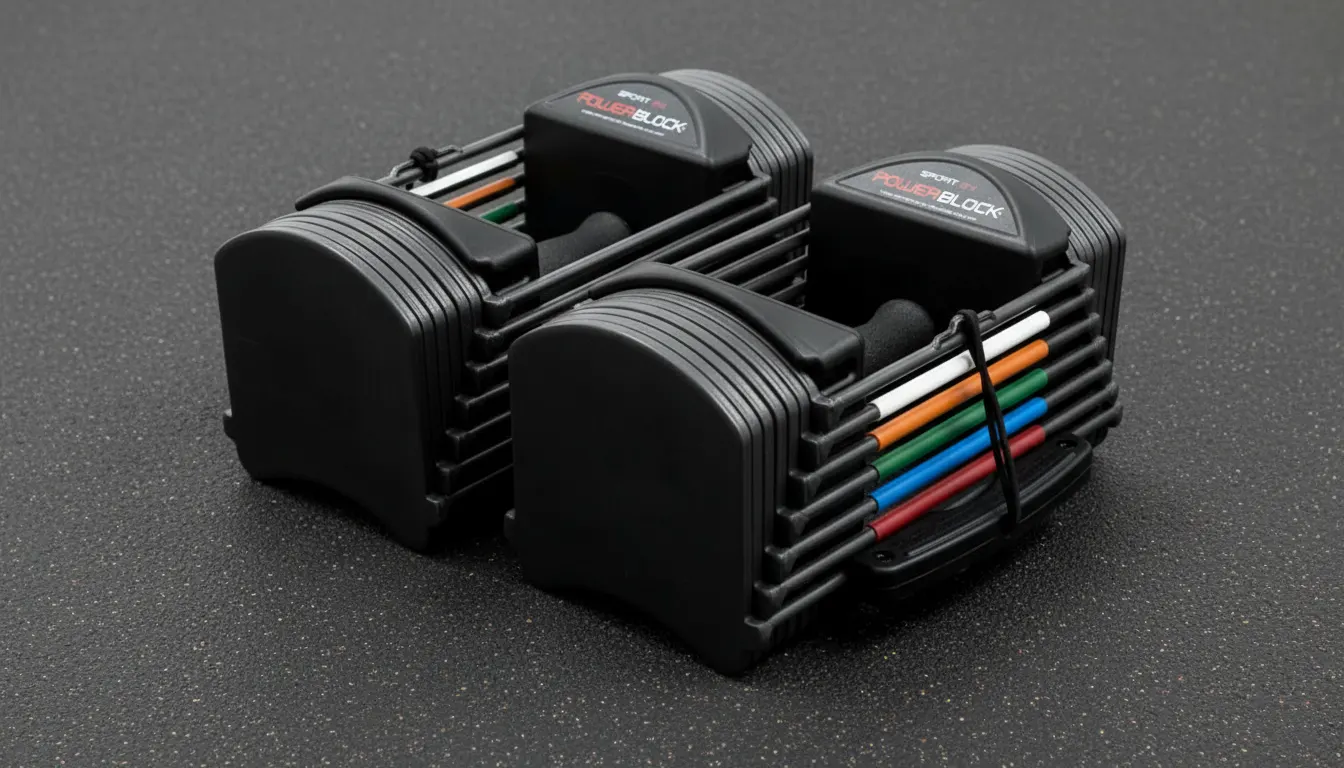
This is where the dumbbell bench press genuinely outperforms the barbell for many lifters. A set of adjustable dumbbells and a flat bench occupy a fraction of the space of a barbell rack setup and cost less. For home gym users without the room or budget for a full power rack, the dumbbell bench press is not a compromise; it is a complete pressing option.
The ceiling on home dumbbell training used to be the limited weight range of fixed-weight sets. Adjustable dumbbells that go up to 90 lb or 100 lb per hand changed that calculation significantly. A 90 lb dumbbell press is a meaningful strength level for most lifters, and anyone who can press that comfortably has built substantial chest development.
Commercial Gym Considerations
In most commercial gyms, the barbell bench is the bottleneck — three benches for forty people. The dumbbell rack is almost always more accessible, and the dumbbell bench press done on a flat utility bench is often the faster, more practical choice during busy hours. This is a minor point, but not an irrelevant one for consistency.
How to Use Both in the Same Routine
Option 1: Barbell as Primary, Dumbbell as Secondary
Run the barbell bench press as your main chest movement, tracked with a specific weight progression (e.g., linear or weekly periodization). Follow it with dumbbell bench press in a higher rep range for volume and hypertrophy work. This structure suits lifters whose strength goals include hitting specific barbell benchmarks or who compete in powerlifting.
A typical setup might look like: Barbell bench press 4 sets of 4-6 reps, followed by dumbbell bench press 3 sets of 10-12 reps, then cable flyes or dumbbell flyes for isolation.
Option 2: Dumbbell as Primary, Barbell as Occasional
This suits home gym users, lifters with mild shoulder sensitivity, or those whose primary goal is aesthetic chest development rather than maximal pressing strength. The dumbbell press becomes the main movement tracked for progression, and barbell pressing appears occasionally — perhaps once every two weeks — to maintain the pattern without making it the focus.
Option 3: Alternating Block Programming
Run a four-to-six week block with the barbell as the primary pressing exercise, then switch to dumbbells for the next block. This periodization approach prevents accommodation, exposes your chest to different loading patterns, and keeps training interesting. Lifters who have been stuck at the same barbell press weight often find that a dumbbell block for six weeks — with higher reps and better stretch — brings them back to the barbell stronger.
Technique Fundamentals for Both Exercises
Barbell Bench Press Form
Set up with your eyes directly under the bar, feet flat on the floor, and your lower back in a natural arch — not an exaggerated powerlifting bridge unless you are competing in that sport. Retract your shoulder blades and pull them down toward your rear pockets before unracking. This scapular retraction protects the shoulder and creates a stable pressing base.
Grip the bar with your thumbs wrapped around it — never use a thumbless grip on heavy sets — at a width that brings your forearms roughly vertical when the bar touches your chest. Lower the bar with control, touching just below your nipple line, and drive back up in a slightly diagonal path toward the rack.
Keep your elbows at roughly 45 to 75 degrees from your torso rather than flaring them out to 90 degrees, which dramatically increases shoulder impingement risk under heavy loads.
Dumbbell Bench Press Form
Getting into position safely matters more with dumbbells. Sit at the end of the bench with dumbbells resting on your thighs, then use your legs to kick them into position as you lie back. This reduces the risk of shoulder strain from trying to muscle heavy dumbbells overhead from a seated position.
Once set up, maintain the same scapular retraction you would use on the barbell. A common mistake on the dumbbell press is allowing the shoulder blades to protract forward as the dumbbells lower, which reduces chest activation and stresses the shoulder capsule. Press out and slightly together at the top rather than simply up — this is what creates the pec contraction the barbell cannot provide.
Control the descent and use the full range of motion that your shoulder mobility allows without forcing the stretch. More range is not better if it requires your shoulders to roll forward to get there.
Who Should Prioritize Each Exercise
Prioritize the Barbell Bench Press If:
You compete in powerlifting, where the barbell bench is a mandatory competition lift. You are a beginner focused on building raw pressing strength quickly, where the barbell’s loadability and progression simplicity work in your favor. You train specifically for athletic performance where horizontal pressing force output matters. You have no significant shoulder issues and want to establish a strong strength baseline.
Prioritize the Dumbbell Bench Press If:
You train at home with adjustable dumbbells and no barbell rack. You have a history of shoulder impingement, AC joint problems, or anterior instability that makes the fixed bar path painful. You are focused on chest hypertrophy and want to maximize range of motion and the stretched-under-load stimulus. You have a notable left-right muscle imbalance you want to address. You are in a later phase of a training block and want to accumulate volume with less joint stress before deloading.
Frequently Asked Questions (FAQs)
Is the dumbbell bench press as effective as the barbell bench press for building chest muscle?
For pure hypertrophy, the dumbbell version is arguably slightly better due to longer range of motion and greater pec activation at both ends of the rep. For building maximal absolute strength, the barbell wins because of superior loadability. Most lifters benefit from both.
How much less weight will I lift on dumbbells compared to the barbell?
Most lifters press 20 to 30 percent less with dumbbells than their barbell one-rep max when comparing total load. A lifter who bench presses 200 lb on the bar might press 70 to 80 lb dumbbells for similar rep ranges.
Can I replace barbell bench press entirely with dumbbells?
Yes, for the majority of gym-goers whose goals are strength, muscle, and fitness rather than powerlifting competition. The dumbbell bench press can build significant chest strength and size without ever touching a barbell.
Is dumbbell bench press safer for the shoulders?
For most people with existing shoulder issues, dumbbells are more accommodating because they allow the arms to move along a natural arc. That said, higher stabilizer demand means dumbbells are not automatically safe — technique and loading matter for both.
Which is better for beginners?
The barbell is often recommended for beginners because it is easier to progress systematically and the technique is more standardized. Dumbbells are also appropriate for beginners and are preferable for home gym contexts or lifters who start with shoulder sensitivity.
Should I do both exercises in the same session?
This is common and effective. Barbell first while you are fresh, then dumbbells for volume work. Doing it the other way around — fatiguing your stabilizers with dumbbells before the barbell — works less well for maximal strength performance.
How do I know when to move up in dumbbell weight?
When you can complete all prescribed sets with proper form at the top of your rep target with two to three reps left in reserve on the last set, you are ready. Jumping weight before that point is the most common reason lifters stall on dumbbell progression.
Does the dumbbell bench press work the inner chest differently?
The pectoralis major does not have separate inner and outer segments in the way this question implies. However, the adduction (bringing arms together) at the top of the dumbbell press does load the sternal fibers of the pec major through a contraction angle that the barbell cannot replicate. Over time, this can contribute to a fuller-looking inner chest.
Which exercise has a higher injury risk?
Acute catastrophic injuries are more associated with the barbell. Chronic overuse injuries from poor technique accumulate with both, but the fixed bar path of the barbell makes it less forgiving of anatomical variation. Proper technique reduces risk substantially for both.
How should someone with a shoulder injury approach these exercises?
This requires professional assessment, not a blog post. Generally, a physical therapist will often begin shoulder rehab with very light dumbbell pressing before progressing to heavier loads, and transition to barbell pressing only once shoulder mechanics have normalized. Do not attempt to press through sharp shoulder pain with either exercise.
In conclusion
The dumbbell bench press vs barbell bench press debate does not have a clean winner. What it has is a correct answer for different contexts.
The barbell bench press is the superior tool for building maximum pressing strength, training the barbell-specific competition lift, and providing structured, measurable long-term progression. The dumbbell bench press offers greater pec stretch, higher stabilizer demand, a shoulder-friendlier movement arc, and a practical advantage for anyone training without a full barbell rack.
For chest development specifically, the dumbbell press edges out the barbell on the quality of the stimulus per rep. For getting absolutely as strong as possible in a pressing pattern, the barbell edges out the dumbbell due to loadability.
If you have access to both, run them together. Use the barbell to build strength and the dumbbell to build muscle and maintain shoulder health. If you only have dumbbells, know that you have more than enough to build a strong, well-developed chest.
Want to burn fat and build muscle at home? Check out The Best Dumbbell Exercises for Weight Loss for effective workouts, proper form tips, and a simple plan to get results faster.