You’ve probably stood in front of the dumbbell rack and wondered whether to grab a barbell instead. It’s one of the oldest debates in the weight room, barbell curl vs dumbbell curl and the answer isn’t “just do both” without any substance behind it. The choice genuinely matters depending on what you’re building, how your joints feel, and where you are in your training.
What Muscles Are Actually Being Trained?
Long Head vs Short Head of the Biceps
The biceps brachii has two distinct heads. The long head runs along the outer upper arm and contributes to that peaked shape visible during a flexed pose. The short head sits on the inner side and adds width and thickness to the overall look. Both heads converge at a single tendon that attaches at the elbow, and both perform the same functions: elbow flexion and forearm supination.
This distinction matters in the barbell vs dumbbell debate because the two heads respond differently based on grip width, wrist rotation, and shoulder position. A fixed-grip barbell keeps both heads working in a relatively uniform pattern throughout the set. Dumbbells, because the wrists rotate freely, allow the long head and short head to be emphasized at different points in the range of motion — particularly at full supination near the top of the curl.
Brachialis and Brachioradialis
These two muscles sit underneath and alongside the biceps and are active in all curl variations. The brachialis is the stronger elbow flexor and, unlike the biceps, it has no role in forearm supination — meaning it gets trained regardless of how the wrist is positioned. The brachioradialis runs along the outer forearm and is most active in a neutral grip, though it contributes across both exercises.
Research published in PMC found that biceps brachii and brachioradialis activation peaked during the ascending phase of curls performed with a supinated grip. Dumbbell curls, which allow active rotation from neutral into supination during the lift, give you access to that activation window in a way a straight barbell cannot.
Barbell Curls
Why Barbell Curls Build Mass
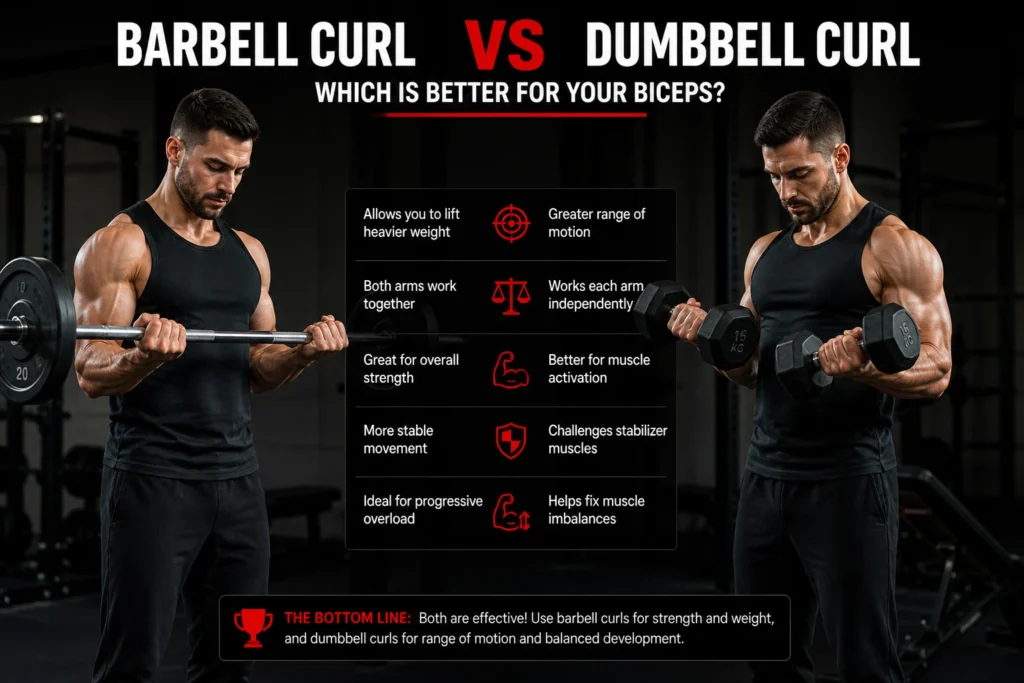
The most obvious advantage of the barbell curl is load. Both arms work together on a single implement, so most lifters can move considerably more total weight than they can with dumbbells. That extra mechanical tension forces greater motor unit recruitment, which drives hypertrophy.
Progressive overload is also more straightforward to manage. You can add fractional plates in 2.5 lb increments, track personal records over time, and progress in a concrete, measurable way. Most dumbbell sets jump in 5 lb increments — you might handle 30 lb dumbbells for 12 reps but only squeeze out 5 or 6 reps with 35s. A barbell closes that gap.
The fixed bar path is another practical benefit. Your hands don’t move relative to each other throughout the set, which removes one variable from the movement. Some lifters find this actually improves their mind-muscle connection because there’s less to manage in terms of wrist control.
Where the Barbell Becomes a Problem
The fixed straight-bar grip is also the barbell’s biggest liability for many people. A straight bar locks the wrists into full supination at a fixed width. For lifters whose natural carrying angle doesn’t align with a fixed bar, this creates uncomfortable torque at the wrist and elbow joints.
Clinical observations consistently show that straight-bar bicep curls are a common source of wrist discomfort in the gym. The triangular fibrocartilage complex — a structure of ligaments and cartilage in the wrist — can be repeatedly compressed under heavy fixed-grip loads. This doesn’t mean barbell curls are inherently dangerous, but joint anatomy varies between individuals, and not everyone tolerates a straight bar at high training intensities.
The bilateral nature is another consideration. Both arms move together, which means a stronger dominant arm will compensate for a weaker side without you ever noticing. Over months of barbell-only training, this can widen an already existing size and strength gap between left and right.
Dumbbell Curls
What Forearm Supination Actually Changes
The most underrated aspect of dumbbell curls is active forearm supination — rotating the palm from facing inward (neutral) to facing upward (supinated) during the curl. A straight barbell forces you to start supinated and remain there for the entire set. Dumbbells let you start neutral and rotate into supination as you lift, so the bicep contracts through a longer functional arc.
This matters because the biceps brachii is a supinator first and an elbow flexor second. When the forearm begins fully supinated (as with a barbell), the bicep enters the movement in a shortened position relative to its supination function. Starting neutral and rotating actively recruits that capacity, potentially engaging more muscle fibers across the range.
Coratella and colleagues (2023) confirmed in a peer-reviewed study that biceps brachii activation was highest with a supinated grip during the ascending phase of curls — the exact position dumbbell curls allow you to reach through active rotation, rather than simply starting there.
Fixing Imbalances That Barbell Training Hides
Dumbbell curls force each arm to do its own work. There’s no shared bar to compensate for. If your left bicep has lagged for months, a barbell program will likely continue masking that gap. Dumbbell curls expose the discrepancy immediately — and performing an extra set on the weaker side directly addresses it over time.
Each arm also follows its own natural arc. If one elbow has slightly different mobility than the other due to old injury or posture, dumbbells accommodate those differences. A barbell requires both arms to travel exactly the same path, regardless of individual anatomy.
Range of Motion Advantage
Dumbbell curls generally allow a greater range of motion than barbell curls. There’s no bar blocking the top of the movement, and the wrists aren’t constrained at the bottom. A larger range of motion across the working muscle means more total fiber length change per rep, which research links to stronger hypertrophy signals over time.
Incline dumbbell curls take this further. Setting a bench to 45-60 degrees and letting the arms hang behind the torso puts the long head of the bicep under a deep stretch at the bottom of every rep. Stretched-position loading is one of the more consistently supported principles in recent hypertrophy research, and it’s essentially inaccessible with a standard barbell curl.
The Load Limitation
The trade-off is that you’ll almost certainly curl less total weight with dumbbells than with a barbell. For strength-focused training phases, this is a real limitation. As dumbbell weight increases, the stabilizing muscles of the wrist and forearm carry more of the burden, and form breakdown tends to happen earlier per set compared to a barbell.
What the Science Actually Shows
EMG Research: No Clean Winner
Electromyography (EMG) studies measure electrical activity in muscles during exercise. The research comparing barbell and dumbbell curls is useful, but the picture isn’t as clean as most articles suggest.
A 2019 study by Oliveira et al. found that barbell curls produced greater peak biceps brachii activation compared to dumbbell curls, attributing this mainly to the heavier loads that barbells allow. The same study noted, however, that dumbbell curls provided more balanced activation across both heads of the biceps — which matters for symmetrical development over time.
Research published in PMC comparing dumbbell curls, straight barbell curls, and EZ-barbell curls found that activation patterns differed between conditions, partly due to the grip changes inherent in the dumbbell curl’s supination arc. The dumbbell curl demonstrated lower activation of both muscles than the EZ-barbell variant in the full exercise — but the dynamic supination arc introduced variables that made direct comparison difficult.
The honest interpretation: neither exercise definitively wins on activation. Barbells produce higher peak mechanical tension through heavier loading. Dumbbells produce better activation quality through a fuller range of motion and active supination.
Load vs Range of Motion
This is the core tension in the barbell vs dumbbell debate. Load produces more mechanical tension per rep. Range of motion produces more total muscle fiber length change per rep. Both are documented stimuli for muscle growth. The question isn’t which is superior in the abstract — it’s which your current training phase is prioritizing.
Most intermediate and advanced lifters benefit from heavy barbell work in lower rep ranges (5-8 reps) alongside higher-rep dumbbell work (10-15 reps). The barbell phase drives dense mass through high-load training. The dumbbell work builds volume, refines activation, and addresses imbalances.
Proper Technique for Each Exercise
Barbell Curl Form
Stand with feet about hip-width apart, knees slightly soft. Grip the bar with a shoulder-width underhand grip. Brace the core, keep the chest up, and pin the elbows at your sides — they should not drift forward during the curl. Lift by contracting the biceps, not by swinging the torso. At the top, hold the contraction briefly before lowering with control. The descent should take at least 2 seconds.
Common errors include letting the elbows travel forward (which transfers load to the front deltoids), using hip momentum to swing the bar, and gripping too tightly (which activates the wrist flexor tendons and strains the inner elbow). Also, cutting the bottom range short removes the stretch stimulus at the bottom of the movement.
If the straight bar bothers your wrists, switch to an EZ-curl bar before abandoning barbell curls entirely. The angled grip reduces torsional wrist stress while preserving most of the load advantage.
Dumbbell Curl Form
Stand or sit with a dumbbell in each hand, arms hanging at the sides with palms facing each other in a neutral grip. As you curl, rotate the forearm so the palm faces upward by roughly the midpoint of the lift. Continue until the dumbbell reaches shoulder height and the bicep is fully contracted. Lower with control, rotating back toward neutral on the way down.
The rotation is what separates a well-executed dumbbell curl from a barbell curl performed with dumbbells. Don’t skip it — that’s where much of the additional value of the dumbbell lies.
Keep the upper arm stationary throughout. Avoid letting the shoulder roll forward at the top, and don’t use body momentum to swing the weight. Whether you curl both arms simultaneously or alternate is personal preference; simultaneous curls are more time-efficient, while alternating allows brief mental focus on each arm independently.
Which Curl Fits Your Specific Goal?
Maximum Mass and Strength
Prioritize barbell curls. The load advantage and ease of progressive overload make it the better tool for driving strength adaptations through high mechanical tension. Program it in the 5-8 rep range with challenging weights, with good form maintained throughout.
Muscle Symmetry and Balanced Development
Dumbbell curls are the better choice. They expose and correct imbalances that bilateral exercises hide. Even lifters who primarily use barbells benefit from periodic dumbbell cycles to ensure both arms develop proportionally.
Beginners
Start with dumbbells. The wrist freedom, lower available loads, and unilateral nature make them more forgiving while learning the basic motor pattern. Once the curl feels natural and you’re handling the load comfortably, adding barbell curls is straightforward.
Wrist or Elbow Issues
Dumbbells nearly always work better here. Free wrist movement accommodates individual joint mechanics without locking you into a fixed angle. If wrist pain persists with dumbbells, hammer curls (neutral grip throughout) or cable curls with a rope attachment reduce wrist stress almost entirely while still training the elbow flexors productively.
Home Gym or Minimal Equipment
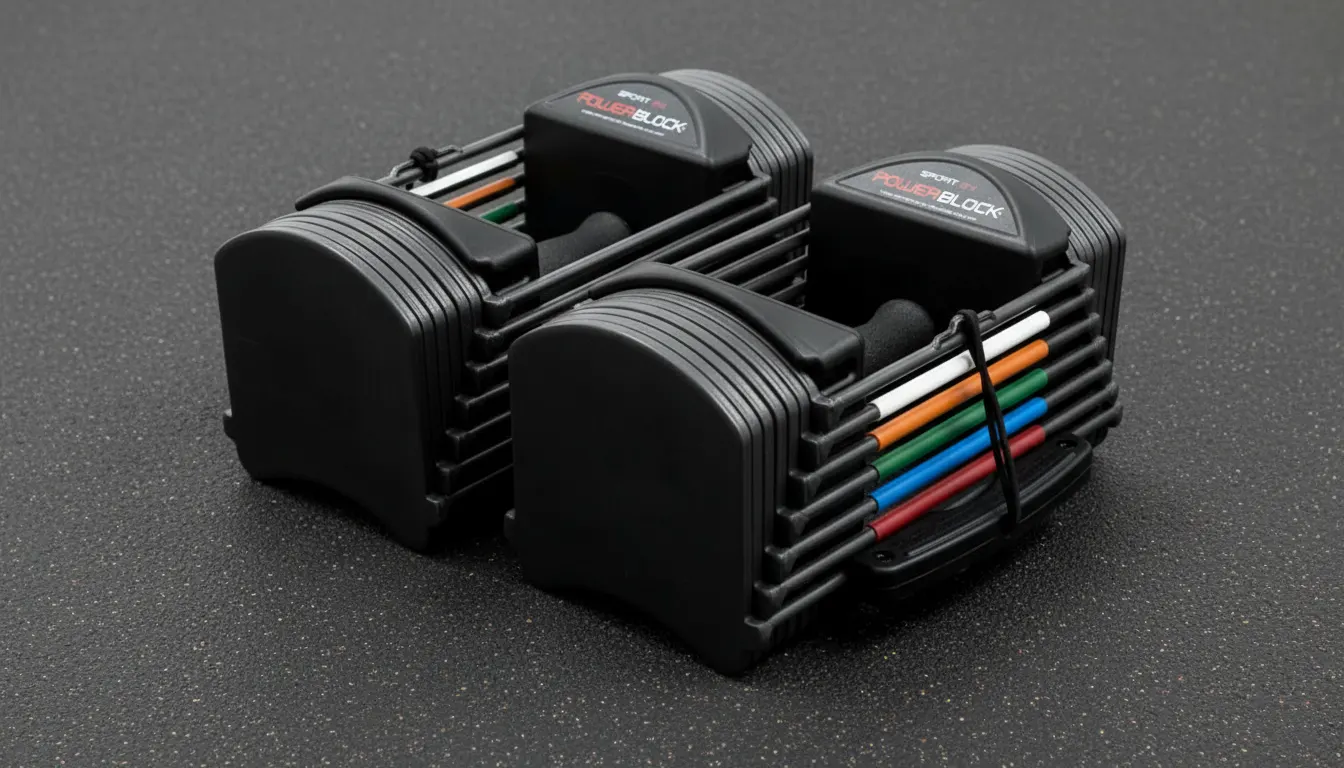
A good dumbbell set covers everything. Adjustable dumbbells handle light warm-up sets through heavy working sets, and the variety of dumbbell curl variations — incline, concentration, hammer, Zottman, cross-body — rivals any barbell-only program in terms of the stimuli you can generate.
How to Program Both in the Same Week
Using both tools across the week tends to outperform an exclusive commitment to either.
A practical structure for an intermediate lifter training arms twice per week:
Session A (strength focus):
- Barbell curl: 4 sets x 6-8 reps at challenging load
- Incline dumbbell curl: 3 sets x 10-12 reps
Session B (volume and detail focus):
- Supinating dumbbell curl: 4 sets x 10-12 reps
- Hammer curl or concentration curl: 3 sets x 12-15 reps
This puts the barbell where it performs best — when the muscles are fresh and you can push heavy loads. Dumbbell work then adds quality volume, covers the range of motion gap, and incorporates the supination stimulus that barbell-only training skips.
For beginners, two to three sets of dumbbell curls two or three times per week produces significant progress without complicating the program. There’s no practical reason to add barbell curls until form is solid and several months of consistent training are behind you.
Form Mistakes That Apply to Both Exercises
Too much weight. The single most common error across both variations. Excess load recruits hip momentum, lower back swing, and anterior deltoid instead of isolating the bicep. The goal is to feel the muscle working — not to move the weight by whatever means necessary.
Shortened range of motion. Partial reps at the top or bottom reduce total muscle fiber engagement per rep. Full extension at the bottom and full contraction at the top both matter for the overall training stimulus.
Fast eccentrics. The lowering phase generates significant muscle damage and growth stimulus. Dropping the weight back to the start in one second wastes half the rep. A controlled 2-3 second lowering on most working sets pays off over time.
Fixed grip width on barbell curls. A wider grip emphasizes the short head; a closer grip shifts load toward the long head. Neither is wrong, but training the same grip width every session limits the variety of stimulus across the bicep.
Skipping forearm rotation on dumbbell curls. Curling from neutral to fully supinated — and actually rotating rather than starting supinated — recruits the bicep through a longer functional arc. Rushing or skipping the rotation turns a dumbbell curl into a fixed-grip curl with lighter weight.
Frequently Asked Questions (FAQs)
Can I build impressive biceps using only dumbbell curls?
Yes. Consistent progressive overload — adding load or reps over time — drives growth regardless of the tool. Most natural lifters hit recovery limits long before they exhaust the load available on a good adjustable dumbbell set.
Why does the barbell hurt my wrists but dumbbells don’t?
A straight bar fixes both wrists into full supination at a set distance apart. For many people, that fixed angle doesn’t match their natural wrist and forearm alignment, creating compressive stress in the triangular fibrocartilage complex. Dumbbells let each wrist find its own comfortable path. If barbell curls consistently irritate your wrists, an EZ-curl bar is a practical step before giving them up entirely.
Should barbell or dumbbell curls go first in a workout?
During strength-focused training phases, barbell curls first makes sense — you’re freshest when it matters most. During hypertrophy phases, order matters less. Some coaches prefer starting with dumbbells to build activation before loading up with a barbell.
Do dumbbell curls actually fix muscle imbalances?
They help noticeably. Because each arm works independently, your stronger side can’t cover for the weaker one. Adding an extra set on the lagging arm accelerates the correction further.
Is the EZ-curl bar a better option than a straight barbell?
For most people with any wrist sensitivity, yes. The angled grip cuts forearm torque without meaningfully compromising the training stimulus. EMG comparisons show slightly higher biceps brachii activation with a straight bar, but the difference is small — and irrelevant if the straight bar causes enough pain to limit your training intensity.
How often should biceps be trained directly?
Two to three times per week with adequate recovery. Keep in mind that rows, pull-ups, and lat pulldowns also heavily involve the biceps, so total bicep volume includes those sessions.
Do I need to do barbell and dumbbell curls in the same workout?
Rarely. They produce similar enough stimuli that stacking both in one session usually adds unnecessary volume rather than meaningfully different training benefit. Alternating between them across sessions or training blocks is more efficient.
What dumbbell curl variation targets the long head most effectively?
Incline dumbbell curls with the bench set to 45-60 degrees. The arms hanging behind the torso creates a deep stretch on the long head at the bottom position. This variation is absent from all standard barbell curl programs and represents a genuine structural advantage of dumbbell training.
Does barbell grip width change which part of the bicep is emphasized?
Modestly. A narrower grip increases long-head involvement; wider shifts toward the short head. The differences aren’t dramatic in practice, but rotating widths across a training cycle ensures both heads receive varied stimulus.
Which is safer for returning from a bicep injury?
Dumbbells, in most cases. Free wrist movement, lower required loads, and unilateral loading let you manage stress on healing tissue more carefully. Cable curls are often even better in early return phases because the resistance curve stays constant rather than peaking and dropping like free weights do. Any return to direct bicep loading after injury should be managed with input from a physiotherapist or sports medicine professional.
In conclusion
The barbell curl and dumbbell curl are not the same exercise delivered through different equipment. They have distinct mechanical properties that produce different outcomes, and understanding those differences is what separates lifters who make consistent progress from those who plateau.
Barbell curls load heavier, progress more cleanly, and produce the kind of mechanical tension that drives dense bicep mass. Dumbbell curls deliver greater range of motion, allow active forearm supination, correct bilateral imbalances, and accommodate individual joint mechanics. Research finds no definitive winner when both are programmed intelligently and consistently.
The most productive approach treats this as a complementary relationship rather than a competition. Heavy barbell curls during strength-focused blocks. Dumbbell variations for volume phases, symmetry work, and joint-friendly loading. Beginners use dumbbells while learning the movement. Advanced lifters draw on both. Anyone dealing with wrist irritation defaults to dumbbells or the EZ bar until the joint can handle more.
Keep adding weight. Control the eccentric. Train consistently. The tool matters less than the commitment to using it well.
Want a complete training split using just dumbbells? Check out Push Pull Legs Dumbbell Workout for an effective routine to build muscle, improve strength, and train your entire body at home.