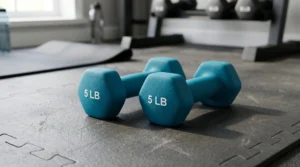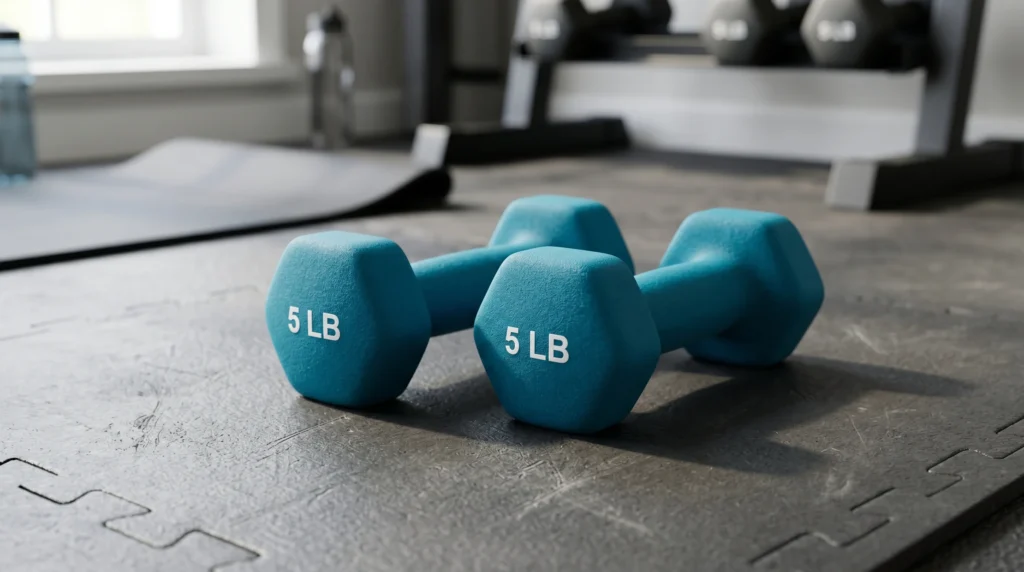
If you’ve ever picked up a set of colorful, soft-coated dumbbells at a sporting goods store and thought “these seem fine,” you’re not alone. Neoprene dumbbells are everywhere. They look approachable, feel comfortable, and don’t clang against the floor. For a lot of people, they work perfectly well.
But neoprene is not without real problems, and if you’re building a serious home gym or training consistently over months and years, those problems are worth understanding before you spend money.
What Is Neoprene, Exactly?
Before getting into the drawbacks, a quick grounding in what neoprene actually is. It’s a synthetic rubber made from polymerized chloroprene, a petrochemical compound derived from crude oil. Manufacturers dip a cast iron dumbbell core into liquid neoprene solution, let it cure, and repeat the process until the coating reaches the desired thickness. The result is the familiar soft, slightly tacky, brightly colored surface you hold during bicep curls or lateral raises.
The coating also includes vulcanizing agents, accelerators, stabilizers, fillers, and pigments — additives that vary significantly between manufacturers. Cheap dumbbells and expensive ones may look similar on the shelf. The difference in those additive profiles has real consequences for durability, chemical safety, and how the coating holds up over time.
The Main Disadvantages of Neoprene Dumbbells
1. Strict Weight Ceiling: Neoprene Tops Out Early
This is the limitation that stops the most people cold. Neoprene dumbbells are almost universally capped at 25 lbs, and most retail options stop at 15 or 20. If you shop at a regular sporting goods store, finding neoprene pairs heavier than 15 lbs can be genuinely difficult. The material and coating process simply aren’t designed for the structural demands of heavy lifting.
Why does this matter? Because strength training requires progressive overload. You need to keep increasing resistance as you get stronger. Someone who starts with 8-lb neoprene dumbbells for bicep curls will, within a few months of consistent training, need 15s, then 20s, then beyond. At that point, the neoprene selection disappears, and they’re shopping for rubber-hex or urethane alternatives anyway.
For beginners, rehabilitation patients, and people doing low-impact cardio or Pilates, this ceiling is irrelevant. But for anyone with intermediate-to-advanced strength training goals, neoprene will become a dead end faster than they expect.
The handle thickness compounds this issue. Heavier neoprene dumbbells — those in the 15-25 lb range — often have noticeably thicker grips because of how the coating wraps the cast iron core. Users with smaller hands frequently report grip fatigue that wouldn’t occur with a standard knurled metal handle at the same weight. That’s a secondary consequence worth knowing before you buy.
2. Coating Degradation: Peeling, Cracking, and Flaking
Neoprene is durable relative to vinyl, but it is not indestructible. Over time, with regular use and normal storage conditions, the coating degrades. The way it fails matters.
Peeling tends to happen first at the seams — where two sections of neoprene meet, or where the coating transitions from the head to the handle. This is the area that experiences the most repeated mechanical stress during gripping and releasing. Once peeling starts at a seam, it tends to spread.
Cracking comes from temperature extremes. Neoprene left in a garage over a cold winter, then moved indoors for summer workouts, contracts and expands with temperature changes. Those cycles stress the polymer structure. UV exposure from sunlight accelerates the process further — the coating becomes brittle, and small surface fractures appear.
Flaking is the final stage, where pieces of the coating separate from the core. At this point the cast iron beneath is exposed, and rust becomes a real concern in humid environments. Flaking fragments can also end up on your floor or hands, and in households with young children or pets, those small pieces of coated rubber pose a choking hazard.
The practical implication: neoprene dumbbells stored properly — indoors, away from direct sunlight, in consistent temperatures — will last considerably longer than those left in a garage or near a window. If you’re buying for a home gym in a climate-controlled space, lifespan is less of a concern. If your “gym” is a corner of an unconditioned garage, you’ll likely see premature degradation within a couple of years.
3. Chemical Concerns: VOCs, Chloroprene, and Skin Reactions
This is the area with the most nuance, and it’s worth addressing carefully rather than either dismissing it or overstating it.
Off-gassing. New neoprene dumbbells often have a distinct chemical smell. That smell comes from volatile organic compounds (VOCs) released as the coating cures and settles. In well-ventilated spaces, VOC concentrations dissipate relatively quickly and are not considered a significant health concern for most people. In small, poorly ventilated home gyms — a basement, a closet, a tiny spare room — VOC exposure is more meaningful, particularly during the first weeks of use. The simple fix is airing out new dumbbells outdoors or in a well-ventilated area for several days before bringing them into your workout space.
Chloroprene. The raw material used to make neoprene, chloroprene, is classified as a probable human carcinogen by the International Agency for Research on Cancer (IARC). This classification is based primarily on occupational exposure data from manufacturing facilities — situations where workers were exposed to concentrated chloroprene over years of daily contact. For the average consumer handling a finished, cured neoprene dumbbell during a 30-minute workout, the exposure level is not remotely comparable. The EPA has noted that occupational exposure during manufacturing is the primary concern, not consumer use of finished neoprene products.
That said, the concern isn’t entirely unfounded. The coating process introduces residual chemicals including phthalates — endocrine-disrupting plasticizers linked in some studies to hormonal effects. The concentration and type of these residuals vary by manufacturer. Budget dumbbells from unverified suppliers may have different additive profiles than certified products from established brands. If you’re buying neoprene dumbbells, checking for ASTM or EN71 certifications is one reasonable precaution.
Allergic contact dermatitis. A meaningful minority of people are sensitive to the chemical accelerators used in neoprene vulcanization — thiurams and carbamates are common culprits. Reactions range from mild skin redness and itching to more pronounced contact dermatitis. The American Contact Dermatitis Society named neoprene among its notable allergens. For most users, this never becomes an issue. But if you notice persistent skin irritation on your palms or fingers after workouts, neoprene sensitivity is a legitimate possibility worth discussing with a dermatologist.
4. Breathability and Hygiene: Sweat Builds Up Fast
Neoprene’s closed-cell foam structure is what makes it waterproof and soft. That same structure blocks airflow. Against a dumbbell, this matters less than it would with wearable neoprene like a wetsuit or knee sleeve — you’re holding a rigid object, not wrapping skin in a membrane. But it’s not irrelevant either.
During high-rep sets or intense HIIT sessions, your palms sweat. Neoprene absorbs that sweat into the surface layer rather than wicking it away. In a commercial gym setting where multiple users handle the same dumbbells, this creates a hygiene issue. The material traps moisture and bacteria more stubbornly than smooth rubber or metal. Cleaning neoprene properly requires a damp cloth with mild soap — and critically, letting it dry completely before storage. If dumbbells go back onto a rack while still damp, that moisture sits in the coating and can degrade it faster.
For home gym users who are the only person touching their weights, hygiene is a lower concern. But the moisture retention still affects how the grip feels during long sets. After enough sweat builds up, neoprene can feel sticky or slightly slick in a way that affects control — the opposite of what you’d want during a challenging exercise.
5. Limited Suitability for Heavy or Impact-Driven Training
Neoprene dumbbells are not drop-safe the way bumper plates are. The coating provides some impact cushioning during accidental drops or careful setting-down, but it isn’t designed for repeated dropping from height. The bond between the neoprene coating and the cast iron core can weaken with impact stress — and once that bond starts to fail, peeling accelerates.
For training styles that involve fast transitions, high-rep swings, or intentional drops — CrossFit-adjacent workouts, ballistic training, kettlebell-style movements — neoprene is the wrong coating. Rubber hex dumbbells or urethane-coated options handle impact significantly better.
There’s also a weight accuracy consideration. Budget neoprene sets sometimes miss their labeled weight by more than a trivial margin. The thick coating adds volume and can make visual estimation difficult. Independent testing of some retail sets found deviations of several percentage points from stated weights, which matters for anyone trying to program progressive overload precisely.
6. Environmental Impact: A Petroleum Product with a Poor End-of-Life Profile
Neoprene is derived from chloroprene, which comes from butadiene — a crude oil byproduct. More than 95% of global chloroprene production still depends on fossil fuel inputs. The manufacturing process emits volatile organic compounds, hydrogen chloride, and carbon monoxide. A chloroprene rubber plant in Louisiana was identified by the EPA as contributing to elevated cancer risks for nearby residents due to airborne pollutants during production.
On the disposal side, neoprene is a thermoset material — its polymer chains cross-link during vulcanization in a way that cannot be reversed by heat. Unlike thermoplastics, thermosets cannot be melted and reformed. That means standard recycling streams don’t accept neoprene. Most neoprene dumbbells that reach the end of their useful life go directly to landfill, where the coating persists for decades without meaningful decomposition.
For buyers who weigh environmental impact in their purchasing decisions, this is a real consideration. Brands like Patagonia and Yulex have moved toward plant-based rubber alternatives partly in response to neoprene’s carbon footprint and end-of-life profile. In the dumbbell market, urethane-coated and uncoated cast iron options are the more environmentally sustainable choices — cast iron is infinitely recyclable, and quality urethane coatings last significantly longer before requiring replacement.
7. Price-to-Durability Ratio at Higher Weights
Neoprene dumbbells in the 1–10 lb range are quite affordable and offer good value for what they are. The calculation changes as you move up in weight. Heavier neoprene pairs — 15–25 lbs — cost more per pound than rubber hex or cast iron alternatives, and they don’t outlast them. If you’re outfitting a full weight progression from 5 to 25 lbs, the total cost of a neoprene set runs meaningfully higher than the equivalent in rubber hex dumbbells, with fewer advantages for serious training.
Commercial gyms rarely stock neoprene above 10 lbs for exactly this reason. The coating wears faster under high-frequency, multi-user conditions, and the economics of neoprene don’t justify the cost at heavier weights. For a home gym used by one or two people with light-to-moderate training goals, this matters less — the per-use cost over years of ownership is reasonable. For anyone building a serious training set, the math doesn’t favor neoprene at the heavy end.
8. Chemical Sensitivity to Cleaning Products
Neoprene reacts poorly to many common cleaning agents. Alcohol-based sanitizers — which became standard in gyms during and after the COVID pandemic — break down the neoprene polymer over time, causing the surface to become sticky, brittle, or discolored. Bleach does similar damage. Abrasive cleaners scratch the surface and accelerate peeling. Petroleum-based products dissolve the coating.
In a home setting, this is easy to manage: use mild soap and water, dry thoroughly, and you’re fine. In a shared or commercial space where cleaning protocols involve stronger disinfectants, neoprene dumbbells degrade noticeably faster. If you’re outfitting a gym with multiple users and standard disinfection routines, chrome, rubber, or urethane-coated options hold up better to those cleaning demands.
Who Should Still Buy Neoprene Dumbbells?
All of the above said, neoprene is genuinely the right call for a specific group of people. The disadvantages mostly surface under conditions that a large portion of dumbbell buyers never encounter.
Beginners doing home workouts with weights in the 3–15 lb range hit almost none of the problems described in this article. At that weight range, the coating holds up fine, the weight ceiling doesn’t matter, and the comfort and noise reduction are real advantages — particularly in an apartment or shared home. Physical therapy patients and people doing rehabilitation exercise fall into the same category. The grip is forgiving, the weights are light, and the softness genuinely reduces hand fatigue during recovery work.
Yoga and Pilates users similarly don’t push neoprene anywhere near its limits. Neither do people running cardio workouts with light resistance. These are exactly the applications neoprene was designed for, and it performs well in them.
Where neoprene stops making sense is when the training gets heavier or the environment gets rougher. Consistent progressive strength training, commercial gym settings, garage gyms in temperature extremes, or anyone who already knows they have rubber sensitivities — these situations call for a different material.
Frequently Asked Questions (FAQs)
Are neoprene dumbbells safe to use every day?
For most people, yes. The VOC concern is most relevant during the first few days with new dumbbells — ventilate them before use. Chloroprene exposure from finished consumer products is at a level well below occupational thresholds. If you have rubber allergies or notice skin reactions, discontinue use and consult a dermatologist.
Why do neoprene dumbbells smell when new?
That smell comes from volatile organic compounds off-gassing from the coating and its additives. It’s most concentrated in the first days or weeks. Airing the dumbbells outdoors or in a well-ventilated area for several days before using them indoors reduces the intensity significantly.
Can neoprene dumbbells cause a rash or skin irritation?
They can, in people sensitive to the chemical accelerators used during vulcanization — particularly thiurams and carbamates. This is not the majority of users, but it’s not rare either. If you develop recurring redness or itching on the palms, neoprene sensitivity is worth investigating.
How heavy do neoprene dumbbells go?
Most retail neoprene options top out at 25 lbs, with the practical range for commonly available pairs sitting at 15–20 lbs. For heavier weights, rubber hex or urethane-coated dumbbells are the standard options.
Do neoprene dumbbells peel over time?
Yes, eventually. The timing depends heavily on storage conditions and usage intensity. Dumbbells kept indoors, cleaned with mild soap, and not dropped from height can last many years before showing meaningful peeling. Dumbbells stored in temperature-variable environments or cleaned with harsh chemicals degrade noticeably faster.
Is neoprene bad for the environment?
It’s not the most sustainable choice. Neoprene is petroleum-derived, its production emits VOCs and other pollutants, and as a thermoset material it cannot be recycled through standard streams. Uncoated cast iron is a more sustainable alternative for environmentally conscious buyers.
Can I use alcohol spray to disinfect neoprene dumbbells?
This is not recommended. Alcohol degrades the neoprene polymer, making the coating sticky and brittle over time. A cloth dampened with mild soap and water is the safer option — and dry the dumbbells thoroughly before storing them.
Are neoprene dumbbells good for progressive overload?
Only up to a point. They work well for beginners building strength gradually in the lower weight ranges. Once you need more than 20–25 lbs consistently, you’ll find neoprene options thin out quickly, and you’ll need to move to other materials anyway.
What’s the difference between neoprene and rubber dumbbells?
Both use synthetic materials over a cast iron core, but rubber hex dumbbells are designed for heavier weights, greater impact resistance, and more aggressive training environments. Neoprene is softer, lighter, and better suited to lighter work. Rubber holds up better to drops, heavy use, and most cleaning protocols.
How do I extend the life of neoprene dumbbells?
Store them indoors in consistent temperatures away from sunlight. Clean them with a damp cloth and mild soap after each use. Dry them before putting them on a rack. Avoid dropping them repeatedly, especially on hard floors. Never clean with alcohol, bleach, or abrasive products.
In conclusion
Neoprene dumbbells are not bad equipment. They’re comfortable to hold, quiet enough for apartment use, and genuinely good for the beginner-to-intermediate weight ranges. There’s a reason they’re the most common coated dumbbell on the market.
The problems are specific, and they matter more than most buying guides acknowledge. The weight ceiling is real. The coating degrades in conditions that a lot of home gyms create. The chemical concerns, while not alarming for casual users, are worth knowing if you’re in an enclosed space, have sensitive skin, or care about what you’re buying your kids. The environmental footprint is significant for a petroleum-derived thermoset that ends up in landfill.
None of that means avoid neoprene entirely. It means buy them for what they do well, store them properly, and don’t expect them to carry you through years of serious progressive training. When you outgrow the weight range, rubber hex or urethane dumbbells are the natural next step, and they’ll handle conditions that neoprene can’t.
Looking for the best chrome options for your home gym? Check out Best Chrome Adjustable Dumbbells to compare top picks, key features, and find the right set for durability, performance, and space-saving training.