
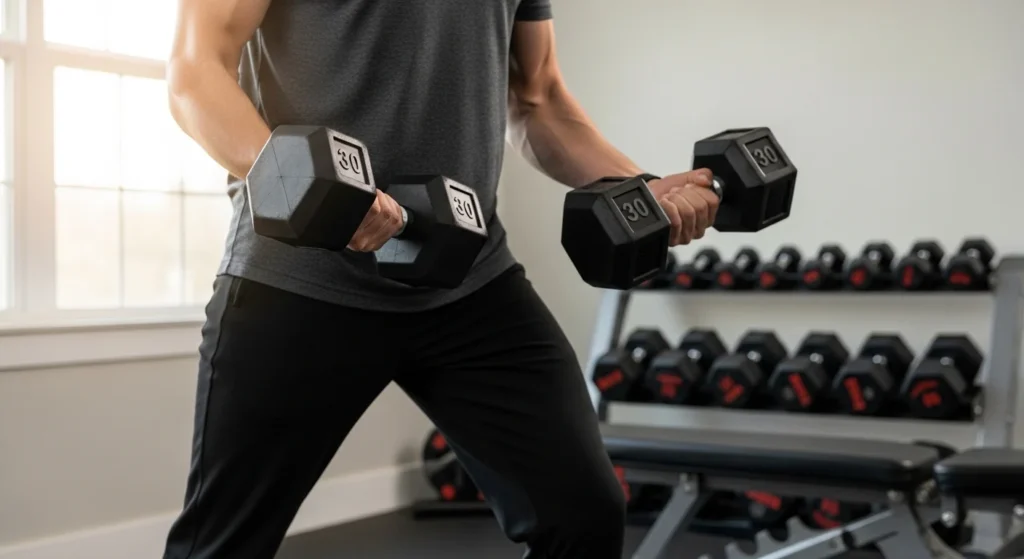
If you’ve spent any time researching home gym equipment, rubber hex dumbbells show up on virtually every best-of list. That’s not marketing noise. After years of lifters testing everything from budget Amazon sets to commercial-grade iron, the same conclusion keeps surfacing: rubber-encased hexagonal dumbbells hit a sweet spot that most other free weight formats can’t match for home and garage gym use.
What Are Rubber Hex Dumbbells?
A rubber hex dumbbell is a fixed-weight free weight with a cast iron or steel core and a hexagonal (six-sided) rubber coating on each head. The handle runs between the two heads and is typically steel—either chrome-plated or fully rubber-coated, depending on the model.
The hex shape isn’t just aesthetic. Round dumbbells roll. Set them down on the floor between sets, and you’ll spend half your workout chasing them across the room. Six flat faces sit flush against the floor and stay there. This matters more than most people realize, particularly when you’re doing push-up variations, renegade rows, or any floor-based exercise where the dumbbell needs to function as a stable base.
The rubber coating handles a different set of problems. It absorbs impact when you set weights down, reducing noise and protecting the flooring. It eliminates the rust issue that eats bare cast iron in humid garage environments. And it creates a buffer if you accidentally drop a weight—not a guarantee against floor damage, but a meaningful improvement over bare metal landing on hardwood or concrete.
Rubber vs. Cast Iron vs. Urethane: The Honest Comparison
Cast Iron Hex Dumbbells
Cast iron hex dumbbells are the cheapest option per pound. They’re uncoated metal—dense, compact, and mechanically durable. The trade-off: they rust in humid garages, they’re louder when set down, and they’ll damage unprotected floors. For buyers on a strict budget who train on rubber matting in a dry climate, they’re a serviceable starting point. For most home gym owners, the floor protection and rust resistance of rubber-coated options is worth the price difference.
Rubber Hex Dumbbells
The rubber coating provides a protective layer over a cast iron core that significantly reduces noise and wear on gym floors compared to bare iron. Most rubber hex dumbbells use recycled or virgin rubber compound over a steel or cast iron core—the heads are rubber, but handles are almost always steel, either chrome-plated or fully rubber-wrapped on certain models. Prices range from under $100 for lighter single pairs to upwards of $5,000 for complete commercial sets. The main drawback is odor: cheaper recycled rubber compounds can smell strong out of the box for weeks. Better manufacturers like REP Fitness use low-odor compounds to address this directly. Since rubber doesn’t corrode, a well-made rubber hex dumbbell will outlast bare cast iron by years in most home gym conditions.
Urethane Hex Dumbbells
Urethane is a synthetic polymer sitting between hard plastic and rubber. It has higher tear strength than standard rubber—in commercial gyms you’ll sometimes see small chips missing from rubber dumbbells where they’ve knocked repeatedly against racks, but this rarely happens with urethane. Urethane is also odorless, resists UV breakdown, and looks newer for longer. Overall, urethane is considerably more durable and longer-lasting than rubber, and far better at withstanding outdoor conditions or direct sun exposure. The catch is price—a urethane set can run two to three times what a comparable rubber set costs. For someone training at home a few days a week, that gap rarely makes financial sense. For a commercial gym with 200 members a day, urethane pays for itself over a decade.
What to Look For When Buying Rubber Hex Dumbbells
Handle Design and Knurling
The handle is the part of the dumbbell you interact with on every single rep. Two configurations dominate the market: ergonomic (contoured/tapered) and straight.
Ergonomic handles taper slightly toward the center, which some lifters find more comfortable during pressing movements. Straight handles maintain a uniform diameter across the full length, providing consistent contact across the entire grip—preferred by lifters who use chalk or want a feel closer to a barbell.
Knurling determines grip security. Too aggressive, and it tears up your palms during high-rep sets. Too smooth and the dumbbell slips when your hands get sweaty. Quality rubber hex dumbbells typically use medium-grade knurling, which suits the wide range of movements dumbbells are used for. Handle diameter also scales with weight: lighter dumbbells under 25 lbs typically use 28mm handles, while heavier options step up to 34mm. A 34mm handle on a 70-lb dumbbell feels noticeably more secure during heavy rows than a narrower one.
Rubber Quality and Odor
Not all rubber is equal. Recycled rubber used in budget options can off-gas a strong smell that lingers for weeks. Some lifters don’t mind it. Others find it genuinely distracting to train around. Virgin rubber is more neutral. Premium low-odor compounds—used by REP Fitness in particular—are engineered to be nearly odorless from day one. If your training space is enclosed, this matters more than specs on paper.
Head-to-Handle Attachment
The junction where the rubber head meets the steel handle is the most likely failure point in lower-quality dumbbells. Friction welding—used by Rogue, REP Fitness, Giant Lifting, and others—creates a bond that is extremely difficult to loosen under normal use. Dumbbells friction-welded at the head-to-handle joint are demonstrably more durable than those using adhesives or simple press-fit designs, which can work loose after repeated drops.
Weight Accuracy
A dumbbell labeled 50 lbs should weigh 50 lbs. Budget options can vary by 5% or more in either direction, which means a “pair” may not actually be matched. Rogue’s rubber hex dumbbells hold a ±3% weight tolerance, which is among the tightest in the market. For most training, a small variance is irrelevant. For serious bilateral strength work where matched resistance matters, tighter tolerance is worth paying for.
Weight Range
Entry-level rubber hex dumbbell sets run from 5 to 50 lbs. More comprehensive options extend to 100 or 125 lbs, covering nearly any movement pattern a serious strength athlete would program. The common mistake is buying too light. Identify where you are now and where you realistically expect to be in 12 to 24 months of consistent training—then size your purchase accordingly. Buying slightly beyond your current working weights usually costs less over time than re-purchasing in stages.
The Best Rubber Hex Dumbbells
Rogue Rubber Hex Dumbbells
Rogue built its reputation on barbells and power racks, and their rubber hex dumbbells hold up to that standard. The grip and knurling on the Rogue Rubber Hex are among the best in any tested lineup—each handle offers enough texture to grab securely without tearing up hands during a workout. The handles are ergonomically contoured and chrome-plated, with knurling isolated to the center section.
The weight variance on Rogue’s rubber hex dumbbells runs ±3%, which is industry-leading compared to cheaper alternatives. Weight options run from 2.5 to 125 lbs—a wider range than most competitors. Sets are sold in three configurations: 5–50 lbs, 55–100 lbs, and 105–125 lbs. One practical limitation: there’s no single 5–100 lb set, so covering the full range requires buying the first two separately.
The medium-grade knurl is appropriate for the high-rep exercises you often do with a pair of dumbbells, and the rubber coating allows dropping from various heights without fear of damaging floors.
Price per pound runs higher than most alternatives. For a full set from 5 to 100 lbs, the cost is substantial. But build quality, tight weight tolerances, and strong resale value make Rogue a sound long-term investment for serious home gym owners.
Best for: Lifters who want a premium, long-lasting set and can justify the cost.
Weight range: 2.5–125 lbs | Handle: Ergonomic chrome-plated, center knurling | Weight tolerance: ±3%
REP Fitness Hex Dumbbells
REP Fitness has become a legitimate competitor to Rogue over the past several years, and their hex dumbbells are a strong reason why. The defining feature is the handle: a straight, fully knurled steel handle at uniform diameter from end to end. Unlike Rogue’s hex dumbbells, REP Fitness has a fully knurled handle at a uniform diameter all the way across, providing optimal grip regardless of where you place your hands during your lift.
The heads are crafted with low-odor rubber that protects both the dumbbells and your floors, and these heads are securely attached via friction welding. Handle diameter scales with weight: 28mm for 5–20 lbs, stepping up to 34mm for 25 lbs and above. At heavier weights, the 34mm handle provides a tactile confidence that promotes cleaner form during loaded movements.
REP Fitness actually charges more than Rogue for individual pairs of dumbbells, but offers a five to 100-pound set as a single purchase—something Rogue doesn’t offer—which can save money for buyers who want full coverage.
Best for: Lifters who prefer barbell-style grip and want odor-free rubber out of the box.
Weight range: 2.5–125 lbs | Handle: Straight, fully knurled chrome steel | Head attachment: Friction welded
REP Fitness Rubber Coated Hex Dumbbells
This is a variation on REP’s standard hex design with one key difference: a full rubber coating across the entire dumbbell silhouette, including the handle, for a comfortable feel that doesn’t freeze hands in cold-weather training environments.
If you train in a garage during winter months, you know the problem—gripping ice-cold steel at 6 a.m. in January is not how you want to start a workout. The fully rubber-coated handle solves this. These dumbbells are also slightly more compact than standard hex options, helping save space on smaller racks.
The trade-off: rubber handles don’t hold chalk as well as bare knurled steel. For everyone who trains without chalk, the grip is sufficient and the cold-weather and rust-resistance benefits are real.
Best for: Garage gym owners in cold or humid climates.
Weight range: 5–100 lbs | Handle: Fully rubber-coated | Notable feature: Rust-resistant from handle to head
Bells of Steel Rubber Hex Dumbbells
BarBend awarded this set their “Best Hex Dumbbells” category designation. The rubber head is sturdy enough to withstand drops, and the lack of rolling during rest between sets is appreciated—no diving under weight benches or racks to retrieve equipment before a set.
One honest caveat: the rubberized heads are made with 50% recycled rubber, which can produce an “old tire” smell similar to bumper plates. If rubber odor is a concern, air these out before use or consider REP’s low-odor option instead.
Build quality is commercial-grade in feel, and pricing sits competitively in the mid-range. Availability can be spottier than Rogue or REP, depending on your region, worth confirming before committing.
Best for: Lifters who want a commercial gym feel at a mid-range price and can tolerate some initial odor.
Amazon Basics Rubber-Encased Hex Dumbbells
For beginners or tight budgets, Amazon Basics rubber hex dumbbells are consistently recommended across independent testing roundups. These earned an NBC Select Wellness Award for their durable build and non-slip textured surface.
The weight range caps at 50 lbs, which limits usefulness for more advanced lifters. The knurling runs more aggressively than most competitors—some testers flagged this during high-rep sets. For a beginner building a first working set fast, the price per pound is hard to beat, and the basic construction handles regular home use well.
Best for: Beginners and budget-constrained buyers who need a working set immediately.
Weight range: 10–50 lbs | Limitation: Caps at 50 lbs, more aggressive knurling
CAP Barbell Rubber Hex Dumbbells
CAP’s rubber hex set stands out because it’s one of the few complete options that includes a storage rack in the purchase. Available in 5 lb increments from 10 lbs up to 120 lbs, the CAP Barbell Rubber Hex Dumbbells have a contoured chrome-plated handle that makes handling comfortable and secure.
For someone outfitting an entire home gym in one purchase, the bundled rack eliminates the separate step of sourcing compatible storage and often saves money over buying components individually. Build quality is solidly mid-range—reliable for consistent home use, not as refined as Rogue or REP at the handle level.
Best for: First-time home gym setups where a rack-and-set bundle delivers better value than buying separately.
Titan Fitness Rubber Hex Dumbbells
Titan Fitness offers rubber hex dumbbells in two handle configurations: stainless steel with knurling for chalk users, and contoured chrome for lifters who prefer an ergonomic grip. Titan hex dumbbell sets fit into strength training regimens whether for hypertrophy work, high-rep circuits, or form-focused training.
Titan offers free shipping, which materially changes the effective price per pound. On heavy sets, shipping can add $40–$80 depending on location and brand. Factoring that in, Titan’s listed price often represents better value than it initially appears.
Best for: Lifters who want a flexible handle choice and transparent all-in pricing with free shipping.
Building Your Set: A Progressive Overload Framework
The most common mistake first-time home gym buyers make is purchasing weights that are too light. It’s an understandable instinct—start conservative, see how it goes. But you outgrow a 5–25 lb set fast if you’re training consistently, and buying in stages usually costs more per pound than buying a broader range upfront.
A practical approach: identify your current working weights for your three or four primary dumbbell movements—a press, a row, a curl, a lateral raise. These will be different weights. Buy pairs that cover those working weights plus the next two or three increments above each. That covers progressive overload for several months without committing to a full 5–100 lb set immediately.
Most rubber hex sets sell in 5 lb increments. At heavier weights above 50 lbs, some sellers offer 10 lb increments, which is workable for most programming. Unilateral training—single-arm rows, Bulgarian split squats, single-arm presses—requires you to be precise about the weight you need, since you can’t compensate the way you might with a barbell loaded with plates.
Training Applications: What Rubber Hex Dumbbells Are Actually Built For
Strength Training and Hypertrophy
Dumbbells require effort to stabilize the weight, which engages smaller muscles that might not be as targeted with machines or barbells, enhancing joint stability and functional strength. This stability demand is particularly valuable for shoulder health—the rotator cuff works harder during dumbbell pressing than barbell pressing, building resilience over time.
Core hypertrophy movements with rubber hex dumbbells: dumbbell bench press, incline press, bent-over rows, Romanian deadlifts, goblet squats, lateral raises, and hammer curls. These movements alone can carry a lifter through years of productive training.
Push-Up Variations
The flat faces of hex dumbbells make them stable platforms for push-up variations, turning a bodyweight movement into a loaded exercise with increased range of motion. Standard hex push-ups, wide push-ups, close-grip variations, and combination push-up-plus-row patterns all work because the heads stay put. Round dumbbells roll away mid-set. This is not theoretical—it’s the kind of thing you only learn after trying it once with the wrong dumbbell.
HIIT and Circuit Training
The rubber coating matters more in HIIT than in standard strength work. Faster transitions, occasional drops, and dynamic movement patterns mean the weight contacts the floor more often and more unpredictably. High-Intensity Interval Training pairs naturally with rubber hex dumbbells, adding resistance to intense bursts of activity, while full-body circuits allow engagement of multiple muscle groups.
Unilateral and Corrective Work
Dumbbells bring options for unilateral training of each side independently, correcting muscle imbalances. This makes them particularly useful for athletes recovering from injury or lifters who’ve developed noticeable strength asymmetry from sport-specific movement patterns. A dedicated unilateral training phase—single-leg work, single-arm pressing, single-arm pulling—addresses these gaps in a way bilateral barbell training cannot replicate.
Maintenance, Storage, and Lifespan
Rubber hex dumbbells are low-maintenance by design. The rubber resists moisture and won’t rust. Wipe them down with a damp cloth after use to clear sweat, and they’ll hold up for years. Avoid harsh chemical cleaners—certain solvents can degrade rubber compounds over time, particularly on cheaper sets where the compound is less refined.
Storage matters for two reasons: organization and rubber longevity. Keeping dumbbells on a rack rather than piled on the floor reduces stress on the rubber coating at contact points where heads knock against each other. A standard three-tier A-frame rack handles most home sets up to 50 lbs. Vertical storage systems work for larger commercial-scale collections.
For the odor issue on new rubber sets, ventilation is the simplest fix. A few days in a well-ventilated space before bringing dumbbells into an enclosed training room lets the initial off-gassing dissipate. It’s not a defect—it’s just the nature of rubber compounds, particularly recycled ones.
Keep heavy dumbbells off bare concrete without matting underneath. Concrete slowly abrades rubber with repeated contact, and the vibration from drops transmits more harshly through concrete than through rubber flooring. Interlocking rubber or foam gym tiles are inexpensive and provide adequate protection.
Price Guide: What to Expect at Different Budget Levels
There’s a real quality cliff at roughly $1.50–$2.00 per pound. Below that threshold, you’re generally looking at inconsistent weight tolerances, stronger rubber odor, and less reliable head-to-handle attachment. Above it, the field narrows to brands that take manufacturing seriously.
Budget range ($0.75–$1.25/lb): Amazon Basics, CAP Barbell individual pairs, Signature Fitness Sporzon. Good for beginners and lighter use. Most cap around 50 lbs.
Mid-range ($1.50–$2.50/lb): CAP Barbell sets with rack, Titan Fitness, Bells of Steel. Solid construction, full weight ranges, better odor control, and free shipping from some brands.
Premium ($2.50–$3.50/lb): Rogue Rubber Hex, REP Fitness Hex, and Rubber Coated. Best construction tolerances, low-odor rubber, superior handle feel, and friction-welded heads.
Commercial/Urethane ($5.00+/lb): Rogue Urethane, REP Urethane, Hampton Fitness DURA-PRO. Designed for daily commercial volume over a 10+ year timeline. Unnecessary for most home gym owners.
For a starter set spanning 5–50 lbs across 10 pairs, budget $400–$600 for entry-level options, $800–$1,200 for mid-range, and $1,200–$1,800 for premium rubber hex.
Mistakes Worth Avoiding Before You Buy
Buying pairs without planning your full range. Purchasing one or two pairs at a time feels economical. You’ll often pay more per pound than buying a bundled set. Map out your full weight range first, then buy.
Overlooking the handle diameter. Lighter dumbbells with narrow handles feel fine. But once you’re pressing 80+ lbs, a 28mm handle becomes uncomfortable and less safe than a 34mm alternative at that load.
Not accounting for shipping. Dumbbells are dense. Shipping a 100 lb pair can add $40–$80, depending on location. Brands offering free shipping on dumbbell orders represent more savings than their listed prices suggest—Titan Fitness and REP Fitness both fall into this category.
Confusing “set” with “pair” listings. Some online listings price a single dumbbell. Others price a pair. Others price a full multi-pair set. Read carefully before adding to cart.
Treating rubber hex dumbbells as slam-proof. They handle accidental drops from normal workout heights without issue. Deliberately dropping from overhead onto hard surfaces will eventually loosen heads or chip rubber. They’re durable, not indestructible—designed for controlled setdowns, not CrossFit-style slamming.
Frequently Asked Questions (FAQs)
Are rubber hex dumbbells safe to drop?
Accidental drops from waist or chest height during normal training are fine—the rubber coating absorbs the impact well. Repeated overhead drops onto hard floors will damage both the dumbbell and the surface over time. They’re not designed as droppable equipment the way Olympic bumper plates are.
How long does the rubber smell last?
Budget sets using recycled rubber can off-gas noticeably for one to three weeks. Premium low-odor options from REP Fitness are almost odorless immediately. Leaving new dumbbells in a ventilated space for a few days before bringing them into an enclosed room speeds up the process considerably.
Should I buy a full set or individual pairs?
If you’re building a complete home gym and will use a range of weights across multiple movements, the per-pound cost on full sets is typically lower. If you only need two or three specific working weights for a focused program, individual pairs make sense.
What’s the difference between rubber hex and neoprene dumbbells?
Neoprene dumbbells are smaller, lighter, and typically max out at 15–20 lbs. They’re designed for aerobic and toning applications. Rubber hex dumbbells cover up to 125 lbs and are built for genuine strength training. They’re categorically different tools despite both having soft outer coatings.
Do I need gym flooring under rubber hex dumbbells?
Rubber flooring is strongly recommended. The hex heads protect floors better than bare iron, but repeated drops and accumulated weight pressure will eventually damage hardwood, laminate, or concrete without matting. Half-inch rubber interlocking tiles are cheap and sufficient.
Are rubber hex dumbbells good for beginners?
Yes. The non-rolling hex design is safer than round dumbbells for beginners still developing coordination. The rubber coating reduces floor damage from inexperienced handling. Weight ranges start low enough that true beginners can train effectively from day one.
What is friction welding, and why does it matter?
Friction welding fuses the steel handle to the iron head using heat generated by rotational friction. The bond is stronger than adhesives and resists loosening from repeated drops and heavy loads. Brands that use friction welding at the head-to-handle joint produce durably more reliable dumbbells than those using press-fit or adhesive connections.
Can rubber hex dumbbells be used outdoors?
Short-term outdoor use is fine—rubber resists moisture better than bare iron. For permanent outdoor storage, urethane is a better choice. UV exposure over time can cause rubber compounds to dry out and crack, whereas urethane resists UV degradation more effectively.
How do I choose between Rogue and REP Fitness hex dumbbells?
Rogue has a slightly more premium feel, tighter weight tolerances, and a wider available range up to 125 lbs in sets. REP offers a fully knurled straight handle that barbell-style lifters often prefer, low-odor rubber that’s ready immediately, and a 5–100 lb set option Rogue doesn’t sell as a single purchase. If the handle feels and immediate out-of-the-box readiness matter most, REP. If you want the wider range and Rogue’s build reputation, Rogue.
What weight should I start with?
Assess your working weights for pressing (dumbbell bench press), pulling (bent-over row), and isolation work (bicep curls, lateral raises). These will differ. Buy pairs covering each of those starting weights plus two or three increments above each. That’s the minimum useful set for someone starting a structured strength program.
In conclusion
Rubber hex dumbbells aren’t a complicated purchase once you understand where the real differences between products actually are. The hex shape solves rolling. The rubber coating handles floors and resists rust. The variables that matter are where brands separate from each other.
Work out your weight range, pick a budget tier, and buy from a brand that uses friction welding on the head joints and low-odor rubber on the coating. That combination will hold up through years of consistent training without surprises.
Want to set up a space-saving home gym? Check out What Are the Best Adjustable Dumbbells? to compare top-rated options, key features, and find the right set for your training needs and budget.


