If you’ve ever stood in front of a dumbbell rack and felt completely paralyzed, you’re not alone. It’s one of the most common questions new lifters ask, and the answer is more nuanced than any chart or “start with 10 pounds” blanket rule will tell you.
The honest answer? Your starting weight depends on your gender, your current fitness level, the specific exercise you’re doing, and what you’re actually trying to achieve. Pick the wrong weight and you’ll either waste your workout or hurt yourself. Pick the right one and you’ll build real, lasting strength in a matter of weeks.
Why Picking the Right Starting Weight Actually Matters
Most beginners either go too heavy out of ego or too light out of fear. Both are costly mistakes — just in different ways.
Going too heavy wrecks your form before your muscles even know what’s happening. You start swinging your hips on bicep curls, arching your back on shoulder presses, and relying on momentum instead of muscle contraction. The result? You train the wrong movement pattern, you don’t actually stress the target muscle effectively, and you put unnecessary pressure on joints and connective tissue.
Going too light has its own problem. If a weight never challenges you — if you can complete every rep of every set without your muscles fatiguing — you haven’t given your body a reason to adapt. Adaptation (getting stronger, building muscle) only happens in response to adequate stress. A 1 kg dumbbell lateral raise done for 20 effortless reps accomplishes very little.
Finding the right beginner dumbbell weight is about striking a balance — something that challenges your muscles but still lets you move with good control. That’s the sweet spot, and everything in this guide is designed to help you find it.
The Core Principle: Let Reps Tell You the Truth
Before getting into specific numbers, understand the rep-range test. It’s the single most reliable way to assess whether a weight is right for you.
Pick a weight. Do 10 to 12 reps of your chosen exercise with strict, controlled form. Then ask yourself three questions:
- Did the last 2–3 reps feel challenging — not painful, but genuinely hard?
- Could you have done 3–4 more reps if you wanted to?
- Did your form stay clean throughout every rep?
If your last few reps were difficult but controlled, you found a good working weight. If you can complete all 8 to 15 reps with a steady technique and the last few feel tough but manageable, the weight is suitable for building strength.
If the weight feels easy across all 12 reps, go heavier. If you can’t complete 8 reps without your form falling apart, go lighter. This self-assessment costs nothing and is more accurate than any online calculator.
What Dumbbell Weight Should You Start With? General Ranges by Gender
Gender is one of the most reliable starting predictors for dumbbell weight — not because of any arbitrary distinction, but because average muscle mass and upper-body strength differ meaningfully between men and women on a population level.
Beginner Men: Where to Start
For men just getting into strength training, the sweet spot is somewhere between 5 to 20 lbs — enough to challenge you without throwing off your form.
In practice, that breaks down like this:
- Small isolation exercises (bicep curls, lateral raises, tricep kickbacks): 10–15 lbs per hand
- Mid-range exercises (shoulder press, bent-over rows): 15–25 lbs per hand
- Lower body and compound movements (goblet squats, Romanian deadlifts, lunges): 20–35 lbs per hand
Most beginner men should use 10 to 20 lb dumbbells for small upper body exercises and 20 to 50 lb dumbbells for stronger moves like rows, presses, squats, and carries. The range exists because your leg muscles — trained every day just by walking — can handle far more resistance than your biceps, which rarely get loaded in daily life.
Beginner Women: Where to Start
For women, 2–5 kg (roughly 5–10 lbs) for upper body and 5–8 kg (10–18 lbs) for lower body is a solid starting framework. That said, these are ranges, not rules. A woman who has played sports her whole life, done years of yoga, or works a physically demanding job may start considerably heavier.
Don’t let the number feel like a ceiling. Many women who start with 5 lb dumbbells are pressing 20 lbs within two months. The starting weight is just that — a starting point.
A Note on Fitness Background
Prior physical activity changes everything. Someone who has been doing yoga three times a week for two years has body awareness, joint stability, and muscle activation that a completely sedentary person doesn’t have yet. Beginners should focus on mastering the movement patterns before significantly increasing the load, but lower body and compound exercises can typically start with heavier weights since leg and glute muscles are larger and stronger from everyday activities.
Starting Weight by Exercise
Bicep Curls
The bicep is a relatively small muscle and gets pulled into a very concentrated contraction during curls. Most beginner men should use 10 to 20 lbs per hand — a weight that lets you curl without leaning back, swinging your elbows, or rushing the lowering phase, because biceps respond better when the movement stays strict and controlled.
For women, 5–12 lbs per hand is a reasonable starting zone. Beginners often start with 5–10 lbs for women to learn control and form.
The tell-tale sign you’ve gone too heavy on curls: your torso swings back as you lift. When that happens, your lower back is doing the work your biceps should be doing.
Lateral Raises
Lateral raises might be the exercise where people most consistently overestimate their appropriate weight. The deltoid — specifically the lateral head — is not a strong muscle, and the leverage involved in raising your arm to the side makes the movement harder than it looks.
Most beginner women should start with 3–6 lbs. Most beginner men should start with 5–12 lbs. These numbers look small and feel humbling in the gym. They’re correct anyway. Swinging 20 lb dumbbells through a lateral raise isn’t a shoulder exercise — it’s a momentum exercise. You’ll feel it in your traps, your neck, and nowhere near your lateral deltoid.
Shoulder Press
Because the shoulder press recruits the entire deltoid along with the triceps and upper chest as stabilizers, you can handle more than you would on a lateral raise. Most beginner men should start around 15 to 30 lbs per hand for dumbbell shoulder press, using the lighter end if shoulders feel unstable, and only increasing when pressing smoothly without arching the lower back.
For women, 8–15 lbs per hand is a practical starting range. The pressing motion becomes more coordinated quickly, so you’ll likely increase weight here faster than on isolation movements.
Dumbbell Rows
Rows target the lats and upper back — large, powerful muscles that can handle real weight. This is one exercise where beginners often underestimate how much they can lift. For beginners doing bicep curls, you might start with 10 lb dumbbells. For goblet squats, perhaps 20–30 lbs. Rows tend to fall in the middle of that range — typically 15–25 lbs for beginner women and 20–40 lbs for beginner men.
Keep your back flat and your elbow pulling straight back rather than flaring out. If your lower back is rounding, the weight is too heavy.
Goblet Squats and Lunges
The legs can take significantly more load than the arms. Your quadriceps, glutes, and hamstrings are among the largest muscle groups in the body, adapted to moving your full bodyweight every day. Heavy dumbbells are reserved for your strongest muscle groups — exercises like goblet squats, Bulgarian split squats, and Romanian deadlifts require substantial resistance to trigger a response.
Beginner women often start with 10–18 lbs for goblet squats. Beginner men typically feel challenged at 20–35 lbs. The weight should be held at chest height for a goblet squat — if your arms can’t hold it there comfortably, your arms are the limiting factor, not your legs.
Romanian Deadlifts
The Romanian deadlift (RDL) is a hinge movement that primarily trains the hamstrings and glutes. It’s one of the best posterior chain exercises you can do with dumbbells, but form is everything. The spine must stay neutral — no rounding. Start conservatively: 15–25 lbs for women, 25–50 lbs for men. Once the hinge pattern clicks, this is an exercise where weight progression tends to happen quickly.
How to Choose Between Toning, Muscle Building, and Strength Goals
Your goal changes not just how heavy you lift, but how many reps you perform and what “appropriate weight” actually means.
Toning and Endurance
“Toning” is really about building a moderate amount of muscle while reducing body fat — two separate processes that happen through different mechanisms. The training side involves using lighter to moderate weights for higher rep ranges. For toning or endurance, choose a lighter weight that allows 12–20 reps per set.
At this rep range, the weight should still feel genuinely hard by the last 3–4 reps. If you can breeze through 20 reps without your muscles burning, you’re not creating the stimulus needed to see change.
Muscle Building (Hypertrophy)
Building muscle requires adequate tension on the muscle fibers. For muscle building (hypertrophy), use a moderate weight that allows 8–12 reps. The last 2 reps of each set should require real effort. Muscle growth occurs when you expose your muscles to stress through resistance training — during workouts, tiny tears form in the muscle fibers, prompting your body to repair and strengthen them.
Strength Training
Pure strength training uses heavier loads and lower rep counts. For strength gains, opt for a heavier weight that challenges you in the 4–6 rep range. Beginners shouldn’t rush into this territory. Spend your first 8–12 weeks building movement competence and base-level hypertrophy before chasing heavy singles.
The Two-Rep Rule for Knowing When to Increase Weight
Knowing when to increase your dumbbell weight is just as important as knowing where to start. The answer isn’t “when it feels easy” — that’s too vague.
A reliable method used by strength coaches: the 2-for-2 rule. If your form stays solid and the last few reps feel challenging but doable, it’s safe to progress. More specifically: if you can perform two extra reps beyond your target for two consecutive workouts, it’s time to increase the weight.
For example, if your goal is 3 sets of 10 bicep curls at 15 lbs, and you’ve completed 12 reps in your third set for two workouts in a row, move to 17.5 or 20 lbs.
The National Academy of Sports Medicine suggests a smart, sustainable increase of no more than 10% per week — this applies to the load itself. So moving from 20 lbs to 22 lbs is more appropriate than jumping from 20 lbs to 30 lbs, even if 30 lbs feels manageable.
Progressive Overload: Why Your Starting Weight Will Change
Progressive overload is the mechanism behind every strength and muscle gain you’ll ever make. The principle is straightforward: your body adapts to the stress you put on it, so the stress must increase over time to keep driving adaptation.
Most beginners should focus on improving repetitions first, then increase weight once the top of the rep range is reached. Small improvements each week lead to steady strength and muscle gains.
The ways to apply progressive overload with dumbbells:
- Add reps (same weight, more reps per set)
- Add sets (same weight and reps, but an extra set)
- Increase weight (same reps, heavier dumbbells)
- Slow the movement down (same weight, but a 3-second lowering phase creates more time under tension)
When you can do 15 reps of any exercise with little-to-no difficulty, drop the number of reps back down and add more weight. This creates a self-regulating cycle where your weight naturally increases as your strength improves.
Beginners experience faster initial gains than anyone else because their neuromuscular system is learning to recruit muscle fibers more efficiently — this is called neural adaptation. Beginners usually see fast progress simply by practicing movements more often and adding small amounts of weight each week. Don’t be surprised if you’re adding weight every week or two in your first three months.
Signs You’re Using the Wrong Weight
Too Heavy
- Your form breaks down before the set ends
- You’re using momentum (swinging, bouncing, leaning) instead of muscle
- You feel it in joints or your lower back, not in the target muscle
- You can’t control the lowering phase — the weight is just dropping
- Sharp pain at any point (stop immediately if this happens)
Too Light
- You finish every set with energy to spare and no muscle fatigue
- You could keep going indefinitely without stopping
- The last rep feels exactly like the first rep
- You’ve been using the same weight for 3+ weeks without any challenge
Fixed vs. Adjustable Dumbbells: What Beginners Should Buy
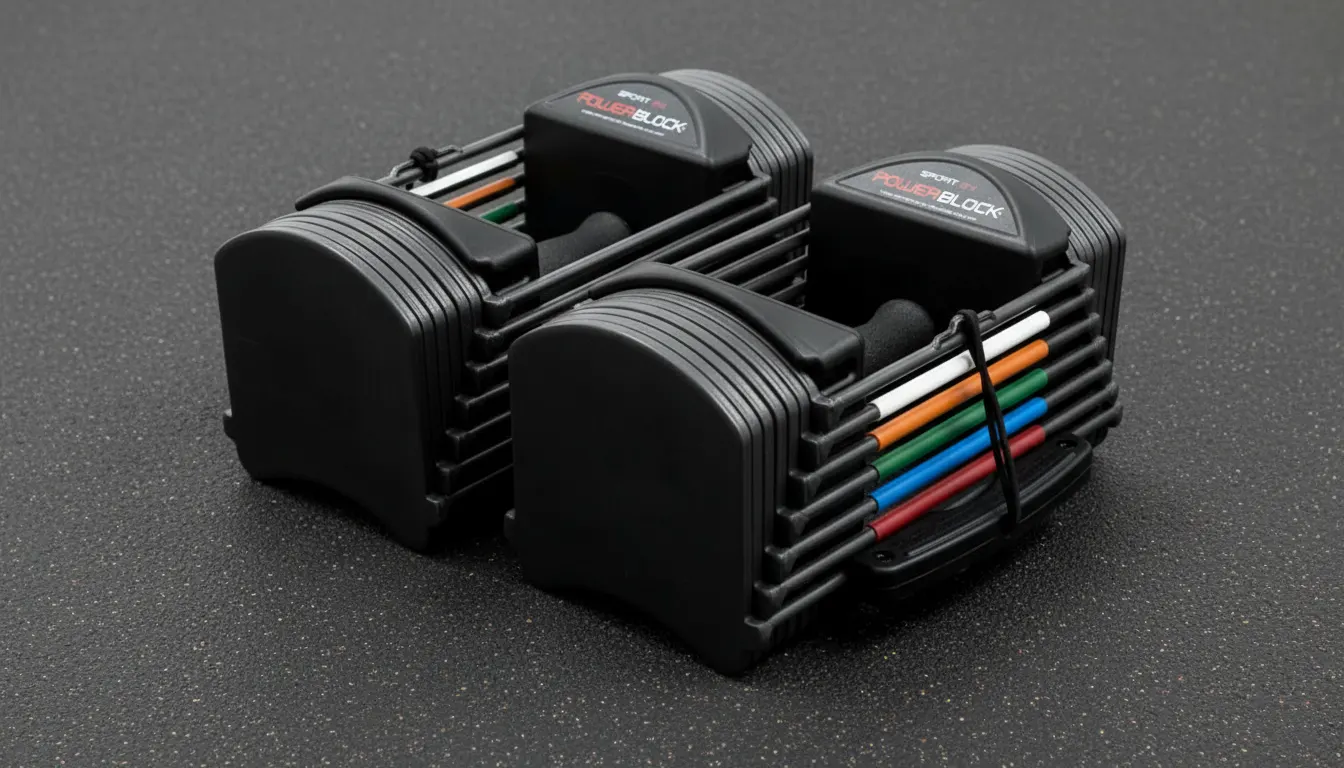
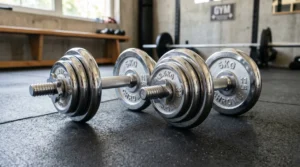
Adjustable dumbbells make more sense for home training. A single pair can replace 10–15 fixed sets, takes up one square foot of floor space, and costs less over time than buying multiple fixed pairs. The trade-off is slightly slower weight changes between exercises and more parts that could break.
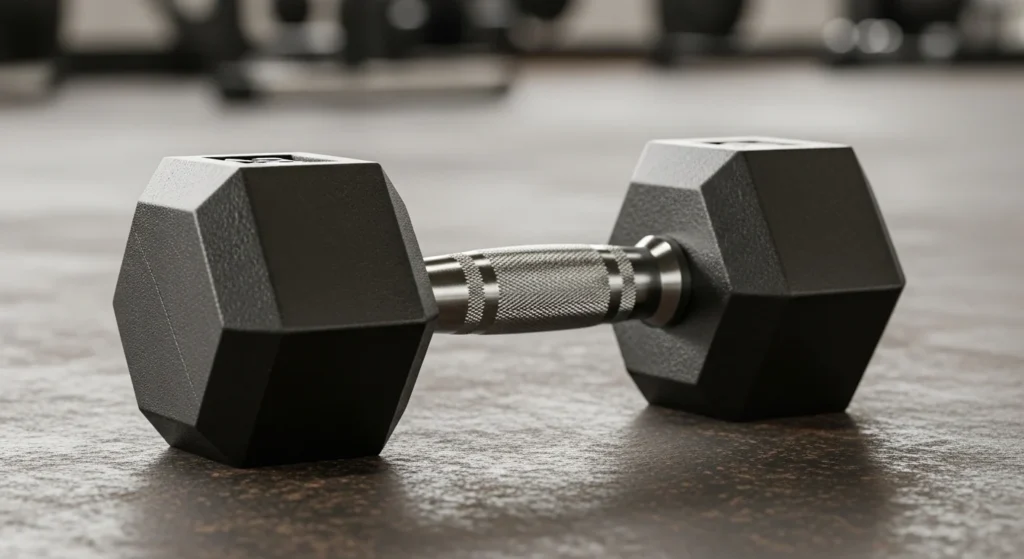
Fixed dumbbells are faster to use and essentially indestructible. They make sense if you have a larger budget, dedicated gym space, or prefer a commercial gym feel. A practical starter setup with fixed dumbbells for a beginner might include pairs at 5, 10, 15, 20, and 25 lbs (for women) or 10, 15, 20, 25, 30, and 35 lbs (for men).
A starter pair in the 5–10 lb and 10–20 lb range works for most people. If you’re training at home, a mixed starter pack gives you variety without overbuying.
One mistake to avoid: buying a single pair and expecting it to work for every exercise. Your goblet squat and your lateral raise will never share the same ideal weight. You need at least two different weight options from day one.
Dumbbell Weight for Seniors: A Different Starting Point
Starting weight recommendations shift for older adults, and for good reason. Joints, connective tissue, and recovery capacity all change with age. That doesn’t mean seniors shouldn’t lift — quite the opposite.
The benefits for seniors are immense, including maintaining muscle mass (which naturally declines with age), improving the ease of daily activities, and significantly reducing the risk of falls.
The starting principle for seniors is “start lighter than you think you need to.” Even 1–2 kg dumbbells (2–4 lbs) can be meaningful for someone returning to exercise or managing joint issues. The focus should be on movement quality and range of motion before weight increases. A doctor or physical therapist should be consulted before beginning, particularly if there are any existing orthopedic conditions.
Dumbbell Weight by Fitness Goal: Quick Reference Table
| Goal | Rep Range | Weight Feel | Progression |
|---|---|---|---|
| Endurance / Toning | 15–20 reps | Challenging by rep 17–18 | Increase every 3–4 weeks |
| Hypertrophy (muscle size) | 8–12 reps | Hard by rep 10–11 | Increase every 1–2 weeks |
| Strength | 4–6 reps | Near max effort by rep 5 | Increase every 1–3 weeks |
| Rehabilitation | 15–25 reps | Moderate effort | Progress conservatively |
Beginner Starting Weight Reference: Exercise by Experience
| Exercise | Beginner Women | Beginner Men |
|---|---|---|
| Bicep Curl | 5–10 lbs | 10–20 lbs |
| Lateral Raise | 3–6 lbs | 5–12 lbs |
| Shoulder Press | 8–15 lbs | 15–25 lbs |
| Bent-Over Row | 10–20 lbs | 20–35 lbs |
| Goblet Squat | 10–18 lbs | 20–35 lbs |
| Romanian Deadlift | 15–25 lbs | 25–45 lbs |
| Chest Press | 8–15 lbs | 15–25 lbs |
| Tricep Extension | 5–10 lbs | 10–18 lbs |
These are starting ranges, not targets. Everyone’s baseline differs. Treat the table as a jumping-off point, not a prescription.
Common Beginner Mistakes and How to Avoid Them
Choosing based on what others are lifting. What someone else lifts is irrelevant to your workout. Their training age, body composition, and goals have nothing to do with yours.
Using the same weight for every exercise. Because only one small muscle is doing the work in isolation movements, using the same weight for a bicep curl as a goblet squat either leaves your arms shaking after two reps or your legs completely unchallenged.
Jumping weight too fast. Increasing by 10 lbs when you’ve been using 15 lbs is a 67% jump. That’s not progressive overload — that’s a recipe for injury. Move in smaller increments, especially on upper body exercises.
Not tracking your workouts. If you don’t write down what you lifted, you’ll either progress randomly or stall. A simple notes app or notebook works fine. Write the exercise, weight, sets, and reps after every session.
Skipping the warm-up. Warm up first with 5 to 10 minutes of gentle cardio — brisk walking or arm circles prepare the joints and muscles for loading. Cold muscles and tendons are more vulnerable to strain.
How to Test Your Starting Weight in 5 Minutes
You don’t need a trainer or a fitness test to find your starting weight. Do this before your first real workout:
- Pick an exercise — bicep curl is a good starting point.
- Choose a weight that seems moderate based on the tables above.
- Perform 10 reps at a controlled pace (2 seconds up, 2 seconds down).
- Rest 60 seconds. Assess how your muscles feel.
- If it was easy, add weight and repeat. If it was too hard, drop weight.
- You’ve found your working weight when the last 2–3 reps are genuinely challenging but your form stays solid.
Repeat this process for each exercise. Your goblet squat weight and your lateral raise weight will be very different, and that’s exactly right.
Frequently Asked Questions (FAQs)
What dumbbell weight should an absolute beginner start with?
For most beginner women, 5–8 lbs for upper body exercises and 10–15 lbs for lower body is a good starting point. Most beginner men do well starting with 10–15 lbs for upper body and 20–30 lbs for lower body. The right weight lets you complete 10–12 reps with your last few feeling genuinely hard.
Is 5 lbs too light to see results?
Not necessarily. For lateral raises, tricep kickbacks, or anyone returning from injury, 5 lbs can be an appropriate and productive working weight. What matters is whether the weight challenges your muscles at the given rep range. If 5 lbs lets you complete 15 reps with your last few being difficult, it’s the right weight for now.
Should men and women use different dumbbell weights?
On average, yes — but with meaningful individual variation. Some women are stronger than some men, particularly in lower body exercises. Use the gender ranges as a starting estimate, then adjust based on your actual performance in the rep-range test.
How quickly should I increase my dumbbell weight?
Most beginners can add weight every 1–2 weeks on upper body exercises and every 1–3 weeks on lower body movements. Keep increases to 5–10% of the current weight. If you’re progressing faster than that, you likely started too light.
Can I build real muscle with light dumbbells?
Yes, if you take sets close to failure. Research consistently shows that lighter loads done to near-failure produce comparable hypertrophy to heavier loads done to near-failure. The key phrase is “near-failure” — you can’t phone in a set with 10 lbs for 10 comfortable reps and expect muscle growth. Push hard within your chosen rep range.
What happens if I start too heavy?
Your form suffers first. You’ll recruit muscles you’re not supposed to be training, reduce the effectiveness of the exercise, and increase injury risk — particularly to joints, tendons, and the lower back. Starting lighter and progressing correctly takes longer on paper but produces better results and fewer setbacks.
Is 10 kg (22 lbs) a good starting weight for beginners?
It depends entirely on the exercise and the person. For a beginner man doing goblet squats, 10 kg is probably light. For a beginner woman doing shoulder presses, 10 kg might be too heavy. Run the rep-range test with any given exercise to get a real answer.
Do I need multiple sets of dumbbells as a beginner?
Ideally, yes. You’ll need different weights for different exercises from day one. If budget is tight, start with two pairs — a lighter set for isolation exercises and a heavier set for compound movements. Adjustable dumbbells are the most space and cost-efficient solution for home training.
Should I feel sore after my first dumbbell workout?
Some muscle soreness 24–48 hours after your first few workouts is normal — this is called DOMS (delayed onset muscle soreness) and reflects your muscles adapting to new stress. Sharp pain during or immediately after a workout is not normal and warrants stopping and consulting a professional.
When should I stop using beginner weights?
There’s no strict timeline. You’ve moved past beginner territory when you’re consistently lifting at the higher end of the beginner ranges with solid form and your progress has slowed from weekly to every few weeks. Most people are in the beginner phase for 3–6 months, depending on training frequency and consistency.
In conclusion
Starting with the right dumbbell weight isn’t about ego and it isn’t about playing it safe to the point of accomplishing nothing. It’s about finding the load that actually challenges your muscles within a rep range suited to your goal, and then adding to that load gradually and consistently over time.
Small improvements each week lead to steady strength and muscle gains. That’s not inspirational language, it’s just how the physiology works. The lifters who make the most long-term progress are usually the ones who started conservatively, stayed consistent, and added weight in small, regular increments rather than making big jumps.
Use the tables in this guide to pick your starting weight, run the rep-range test to confirm it, write down what you did, and add a little more weight when it gets too easy. That’s the entire system. Repeat for years and the results follow.