Most gym-goers walk right past this exercise. They load up the leg press, hammer out some leg curls, and call it a day. Meanwhile, the dumbbell good morning sits there.
This is not a flashy exercise. You won’t see it in highlight reels or trending workout videos. But coaches who understand hamstring development and spinal erector strength have programmed it for decades, and for good reason. The hip hinge pattern it teaches transfers directly to deadlifts, squats, and real-world movement.
What Is the Dumbbell Good Morning?
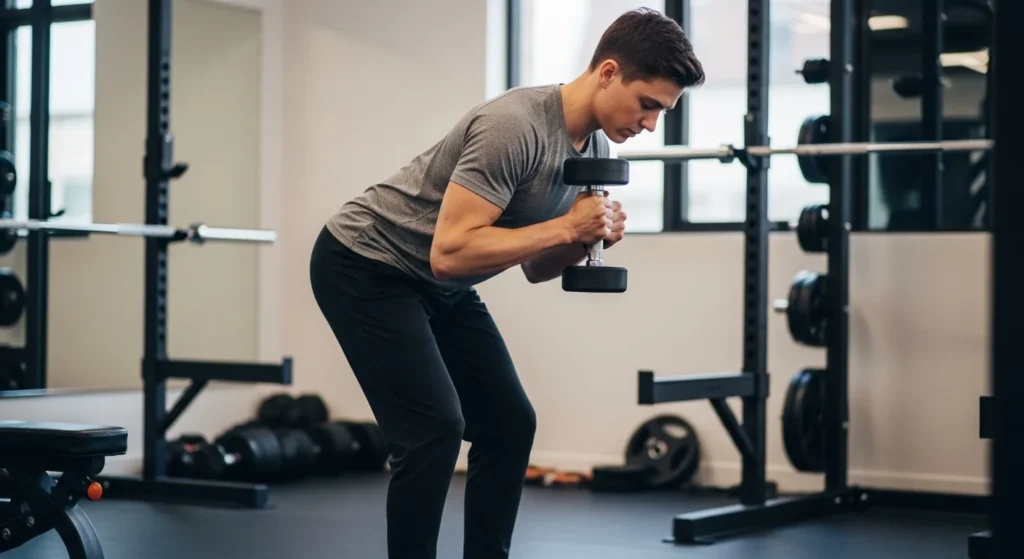
The dumbbell good morning is a hip hinge exercise that trains the posterior chain — the group of muscles running along the back side of your body from your calves to your neck. You hold dumbbells either across your shoulders, hugged at your chest, or hanging at your sides, then push your hips back and lower your torso toward the floor while keeping your spine flat. At the bottom of the movement, your hamstrings are fully lengthened under load. You then drive your hips forward to return to standing.
The name comes from the motion itself: the forward bow resembles a polite morning greeting. Less poetic, more useful — it trains your hamstrings through a long range of motion that most exercises miss entirely.
The movement emphasizes hip mobility and back strength, improving posture and stability, and works as a versatile exercise suitable for all fitness levels, offering a low-impact alternative to enhance lower back and hamstring flexibility and strength.
Using dumbbells rather than a barbell has real practical advantages. The load sits away from your spine, reducing axial compression. Each side of the body works independently, which helps identify and correct left-to-right strength imbalances. And for anyone learning the hip hinge pattern from scratch, starting with a manageable dumbbell load builds technique faster than jumping straight to a loaded barbell.
Muscles Worked During Dumbbell Good Mornings
Primary Muscles
Hamstrings (Biceps Femoris, Semimembranosus, Semitendinosus)
Good mornings train your hamstrings in a lengthened position, which is great for building muscle. Most hamstring exercises — leg curls especially — work the muscle when it’s shortened. The good morning does something different: it loads the hamstrings at full stretch, which research consistently shows produces greater hypertrophic stimulus. This is why the exercise builds both flexibility and strength simultaneously.
Glutes (Gluteus Maximus)
A slightly straighter knee and deeper hinge biases the hamstrings, while driving hard through hip extension lights up the glutes. The glutes take over as you push your hips through to the top of the rep. Squeezing them deliberately at lockout increases their involvement and improves the training stimulus.
Erector Spinae
These three muscles — iliocostalis, longissimus, and spinalis — run the full length of your spine. During dumbbell good mornings, they work isometrically to hold your back flat against the pull of gravity as you lower. Strengthening them through dumbbell good mornings helps you avoid lower back pain and improves performance in other lifts.
Secondary Muscles
Core (Transverse Abdominis, Obliques)
A tight core keeps everything aligned. Without proper bracing, you’ll lose stability. The deep abdominal muscles brace the spine from the front while the erectors hold it from the back — the two systems work together to keep your torso rigid throughout each rep.
Adductor Magnus
Often overlooked, the adductor magnus functions as a secondary hip extensor alongside the glutes. Its involvement in good mornings is one reason the exercise transfers so well to compound movements like the squat and deadlift.
Stabilizers
Smaller muscles work hard too. Your adductors and calves help stabilize your stance, while your forearms strengthen from holding the dumbbells in place.
How to Do the Dumbbell Good Morning: Step-by-Step
There are two main grip positions for good mornings with dumbbells. The shoulder-loaded variation mimics the feel of a barbell good morning more closely. The chest-held variation is easier to set up and slightly more beginner-friendly. Both work.
Shoulder-Loaded Dumbbell Good Morning
Setup: Choose two dumbbells of the same weight and place one dumbbell over each shoulder, with one head of the dumbbell behind your shoulder and the other head in front of your shoulder. Stand with your feet hip-width apart, knees slightly bent.
The Hinge: Take a full breath into your belly and brace your core hard before you move. Push your hips straight back — not down. Your shins should stay nearly vertical. Lower your torso by hinging at the hip joint, not by bending at the waist. Keep your chest up and your back flat throughout the descent.
Bottom Position: Stop when you feel a stretch in the hamstrings. For most people this lands somewhere between 45 degrees and parallel to the floor. Do not force depth beyond what your hamstring flexibility allows — rounding the lower back to go deeper defeats the purpose entirely. Pause for one second at the bottom.
The Return: Drive your hips forward powerfully to return to standing. Drive your hips forward to return to the starting position, squeezing your glutes at the top. Do not hyperextend at the top — stand tall with glutes contracted and hips neutral.
Chest-Held Dumbbell Good Morning
Grasp a dumbbell in both hands by its heads and hold it across your chest. Roll your shoulders back and down. Stand with your feet about shoulder-width apart and bend your knees slightly.
The mechanics of the hinge remain identical to the shoulder-loaded version. The chest hold is slightly easier on the wrists and upper traps, making it a smart choice if the shoulder position feels awkward initially.
Key Technique Cues
A few cues that work well across different lifters:
- Think “push the wall behind you with your hips” rather than “lean forward”
- Keep your shoulder blades pulled together and down throughout
- Imagine holding a pencil between your shoulder blades — do not let it fall
- Your head follows your spine — neutral neck, eyes looking at the floor a few feet ahead
- Breathe in at the top, hold during the descent and pause, exhale on the way up
Common Mistakes and How to Fix Them
Rounding the Lower Back
This is the one mistake that turns a productive exercise into a potential injury. Rounding the lower back increases injury risk because it transfers load from the muscles onto the passive structures of the spine — discs, ligaments, facet joints — that are not designed to handle it under dynamic loading.
The fix: lighten the weight. Rounding almost always means the load exceeds your current strength and mobility. Start with less weight and focus on keeping your chest up and back flat. Practice in front of a mirror or film a set to check your position honestly.
Hinging at the Waist Instead of the Hip
Bending at the waist looks similar to hinging at the hip but produces a completely different stress pattern. Waist-bending rounds the lumbar spine immediately and removes tension from the hamstrings. Bending at the waist instead of the hips reduces posterior chain activation.
The fix: place your hands on your hip creases and physically push them back. This sensation — driving the hips rearward while the torso follows — is the hip hinge. Practice it against a wall: stand six inches from a wall and push your hips back to touch it.
Locking the Knees
Letting the knees lock out limits mobility and can cause strain. A small, consistent bend at the knee keeps the hamstrings optimally loaded and reduces stress on the posterior knee structures. The bend does not need to be dramatic — just enough that the legs are not rigid.
Using Too Much Weight Too Soon
You should use between 60 and 80% of your dumbbell deadlift one rep max when performing good mornings. That number tends to surprise people — it feels like a lot until you realize that good mornings work the posterior chain through a demanding range of motion with near-isometric spinal erector engagement. Start lighter than you think you need to, and earn heavier weights through consistent form over several weeks.
Tilting the Head Back
Tilting the head upward disrupts spinal alignment. Where your head goes, your upper spine follows. Looking straight ahead or slightly down keeps the cervical spine in line with the rest of the back.
Finishing With a Hip Thrust
Do not push your hips too far forward at the top of the rep — focus on squeezing your glutes. Hyperextending at lockout compresses the lumbar spine and adds zero training benefit. Stand tall, squeeze, done.
Dumbbell Good Morning Variations
Seated Dumbbell Good Morning
Sit on the edge of a bench with legs apart and feet flat on the floor. Hold a dumbbell at your chest or across your upper back. Hinge forward from the hips, maintaining a flat back, until your torso approaches your thighs or you feel a strong hamstring stretch. Return to upright.
This seated version limits leg movement, forcing your lower back and core to do more work. Because the glutes cannot assist the movement as freely as they do when standing, the erector spinae must pick up more of the load. This makes the seated variation effective for isolating lower back strength — though it demands very clean technique since there is less room for compensatory movement.
The weight used for seated good mornings is often 20-40% of your best back squat.
Single-Leg Dumbbell Good Morning
Hold one or two light dumbbells and balance on one leg with a slight bend at the knee. Hinge forward, extending the free leg behind you for counterbalance, until your torso and rear leg form a flat line. Drive the planted hip forward to return to standing.
The single-leg good morning primarily improves stability at the hip by working the surrounding musculature that allows it to move while maintaining proper relationships with the foot and back, and helps build and maintain strength, stability and mobility symmetry in the hips.
Load is very light for this variation — the balance challenge more than compensates. It works well as a warm-up, a corrective tool for side-to-side imbalances, or a finisher at the end of leg day.
Paused Dumbbell Good Morning
Standard setup and execution, but hold the bottom position for two to four seconds before returning to standing. The pause eliminates the stretch-reflex contribution — you cannot bounce out of the bottom — so the muscles must generate force from a static position. This increases time under tension and teaches controlled strength through the full range of motion. It is harder than it looks.
Tempo Dumbbell Good Morning
Slow the eccentric (lowering) phase to three to five seconds while keeping a normal concentric pace. Slower eccentrics increase mechanical tension and muscle damage — two of the three primary mechanisms of hypertrophy. This variation works particularly well for people who want to build hamstring mass rather than primarily improve their hip hinge mechanics.
Dumbbell Good Morning with Resistance Band
Loop a resistance band around a fixed anchor at low height and place it across your upper back, then add dumbbells in your hands or across your shoulders. The band increases tension as you return to standing, loading the top portion of the movement where free weights tend to make things easier. This creates more consistent tension across the full range of motion.
Dumbbell Good Morning vs. Romanian Deadlift
Coaches frequently debate which is more valuable. The honest answer is that they train the same muscles but through a meaningfully different loading pattern.
| Factor | Dumbbell Good Morning | Romanian Deadlift |
|---|---|---|
| Load position | Across shoulders or chest | Hands at sides |
| Spinal loading | Higher (axial) | Lower |
| Hamstring emphasis | High, especially mid-hamstring | High |
| Glute involvement | Moderate | Moderate to high |
| Technique complexity | Moderate | Lower |
| Max load possible | Lower | Higher |
| Best use | Hip hinge refinement, erector strength | General strength, heavier loading |
The good morning dumbbell variation isolates your hamstrings more directly. The RDL allows heavier loads, but good mornings teach finer control and balance.
For most training programs, both have a place. The Romanian deadlift handles heavier loading for strength development. Good mornings reinforce the hip hinge with a challenging spinal erector demand and strong hamstring stretch — especially useful for anyone preparing to progress toward heavier barbell lifts.
Benefits of Dumbbell Good Mornings
Posterior Chain Development
Good mornings are an effective exercise for building strength in the hamstrings, glutes, and lower back, as well as improving hamstring flexibility. Training these muscles together through a compound hip hinge produces strength that carries over to virtually every athletic movement and lower body lift.
Improved Hip Hinge Mechanics
Performing good mornings can help to improve other hip hinge exercises like deadlifts and squats. Many lifters plateau on their deadlift not because their legs are weak but because their hamstrings and erectors cannot maintain position under load. Good mornings address that directly.
Lower Back Resilience
Promotes better posture by strengthening postural muscles that support spinal alignment, and builds resilience in the lower back and hamstrings, especially for athletes and lifters. A well-conditioned erector spinae is protective — it handles load more efficiently and fatigues less quickly, which reduces injury risk during other exercises and daily activities.
Functional Carry-Over
The hip hinge movement pattern used in dumbbell good mornings mimics many real-life movements, such as picking up objects from the ground. Improving strength in this pattern can enhance daily functional abilities. The ability to hinge and load the posterior chain without rounding the spine is one of the most important movement patterns for long-term back health.
Athletic Performance
Strong hamstrings and glutes contribute to explosive movements, better sprinting speed, and enhanced jumping ability. Athletes in speed and power sports benefit considerably from training the hamstrings in their lengthened position, as hamstring strains frequently occur in the eccentric phase of sprinting — precisely the position good mornings train.
Accessibility
Low equipment requirement — requires just one dumbbell and minimal space, making it perfect for home workouts. You do not need a squat rack, a barbell, or a machine. A pair of moderately loaded dumbbells and enough space to stand is all it takes.
How to Program Dumbbell Good Mornings
Frequency
Two to three sessions per week works well for most people. The posterior chain recovers efficiently as long as total volume per session stays reasonable. Avoid programming good mornings on consecutive days without an adequate recovery window.
Sets, Reps, and Load by Goal
| Goal | Sets | Reps | Load | Rest |
|---|---|---|---|---|
| Beginners / Learning form | 2-3 | 10-12 | Light (bodyweight or very light DB) | 60 sec |
| Hypertrophy | 3-4 | 8-12 | Moderate (60-70% of DB deadlift 1RM) | 60-90 sec |
| Strength | 3-5 | 5-8 | Moderate-heavy | 2-3 min |
| Mobility / Rehab | 2-3 | 12-15 | Light, slow tempo | 45-60 sec |
For beginners, perform 2 to 3 sets of 10 to 12 reps with light weight, focusing on hip hinge form. For hypertrophy, use moderate weight for 3 to 4 sets of 8 to 10 reps, emphasizing the stretch and glute squeeze.
Where to Place It in a Workout
As an accessory exercise: After your primary compound movement (squat, deadlift, or leg press), add 3 sets of dumbbell good mornings as a direct posterior chain accessory. They pair well with Romanian deadlifts, leg curls, and hip thrusts.
As a warm-up: Light dumbbell good mornings before squats or deadlifts activate the hamstrings and erectors, reinforce the hip hinge pattern, and prepare the posterior chain for heavier loading. Use two sets of 10-12 reps with minimal weight.
On pull days: In push/pull programming, the good morning fits naturally on pull days alongside rows, deadlifts, and hamstring exercises.
Progression
Add weight only when your form is consistently clean through the full range of motion. A reasonable progression is 2.5 to 5 lbs per dumbbell every one to two weeks for beginners. As you get stronger, progress will slow — at that point, adding a set, slowing the tempo, or extending the pause at the bottom adds challenge without requiring heavier weights.
Safety Considerations
Dumbbell good mornings are safe for most people when performed with proper technique and appropriate load. A few categories of lifters should exercise additional caution.
Anyone with existing lower back pathology — disc herniations, spondylolisthesis, or active pain — should consult a physiotherapist or physician before attempting this exercise. The spinal erector loading, while beneficial for most, can aggravate certain conditions.
Excessive rounding or arching of your lower back can lead to low back pain, especially under load, so keep your neck, upper back, and lower back in alignment and maintain a flat back throughout the movement.
To protect your core, keep it braced, as if you were preparing to receive a punch, throughout the exercise.
Always warm up before loading the posterior chain. Five to ten minutes of light cardio followed by bodyweight or banded hip hinges is sufficient for most people. Never skip the warm-up set on working weight — one light set before your heavier sets lets you confirm form before the stakes are higher.
Frequently Asked Questions (FAQS)
How heavy should I go on dumbbell good mornings?
Start lighter than your instinct suggests. You should use between 60 and 80% of your dumbbell deadlift one rep max. Most people overestimate how much they can handle in this movement without breaking form. If you cannot maintain a flat back through the full range of motion, the weight is too heavy.
Are dumbbell good mornings safe for the lower back?
When performed with proper hip hinge form and a neutral spine, good mornings strengthen your lower back and protect against injury. The exercise becomes unsafe when the lower back rounds under load. The movement itself is not inherently risky — poor execution is.
How far should I hinge down?
Lower until you feel a deep hamstring stretch while maintaining a flat back. You do not need to go parallel if flexibility or form is compromised. Depth is individual. Some people reach parallel easily; others feel a strong hamstring stretch at 45 degrees. Work within your current range and it will improve over time.
Can beginners do dumbbell good mornings?
Yes. Beginners can do good mornings so long as they are careful with form. Begin with banded, dumbbell, kettlebell, or bodyweight versions to learn the pattern. The dumbbell version is actually the recommended starting point because the load is more manageable and the weight is easier to drop if needed.
How many times per week should I do good mornings?
The dumbbell good morning can be performed 2-3 times per week, depending on your overall workout routine and recovery needs. Monitor how your hamstrings and lower back feel in the days following your sessions. Persistent soreness that does not clear by the next scheduled session means you need more recovery time.
Should I do good mornings before or after squats and deadlifts?
After, in most cases. Fatiguing the posterior chain before your primary compound lifts reduces their quality and increases injury risk. Use good mornings as an accessory movement following your main work, or as a light warm-up with very minimal loading before heavy sets.
What is the difference between a good morning and a Romanian deadlift?
Both are hip hinge exercises that train the hamstrings and glutes. The primary difference is load position — dumbbells rest on the shoulders or chest in good mornings, while they hang in the hands for RDLs. Good mornings demand more from the spinal erectors and teach hip hinge mechanics with a slightly different feel. Romanian deadlifts allow heavier loading and are typically the better choice for raw strength development.
Can I do dumbbell good mornings at home?
Yes. The exercise requires only dumbbells and enough room to stand and hinge freely. It is one of the most effective posterior chain exercises available for home training setups.
What muscles are worked most in dumbbell good mornings?
The primary muscles trained are the hamstrings, gluteus maximus, and erector spinae. Secondary muscles include the core stabilizers, adductor magnus, and the smaller stabilizing muscles of the ankle and foot.
Do good mornings build glutes?
They do, though not as directly as hip thrusts or certain squat variations. Good mornings build glute engagement by helping to isolate and activate glutes at the top of the lift for improved strength and aesthetics. For maximum glute development, program good mornings alongside direct glute exercises like hip thrusts rather than relying on them as your sole glute movement.
In conclusion
The dumbbell good morning earns its place in any serious training program. It builds the hamstrings in their lengthened position, develops spinal erector strength that protects the lower back, and reinforces the hip hinge mechanics that underpin every major compound lift you do.
It is not complicated. The setup is simple. The technique takes a few sessions to dial in, and staying honest about load selection in the early weeks pays off in consistent, injury-free progress. Anyone from a complete beginner with bodyweight to an experienced lifter working with moderately loaded dumbbells can use this exercise productively.
Not sure which weight to begin with? Check out What Dumbbell Weight Should I Start With? for practical guidance on choosing the right load based on your strength level and goals.