Most people grab a pair of dumbbells, hold them wherever feels natural, and squat. That works, until it doesn’t. The position where you hold those dumbbells changes which muscles you hit hardest, how upright your torso stays, how much your lower back works, and whether you can actually move through a full range of motion without wobbling all over the place.
This is not a subtle difference. Holding dumbbells at your sides targets your posterior chain differently than holding one at your chest, and that’s different again from racking two dumbbells on your shoulders. The weight is the same. The squat is technically the same movement. But your body is doing something genuinely distinct in each case.
Why Dumbbell Position in a Squat Actually Matters
Before getting into the specific positions, it helps to understand why any of this matters mechanically.
When you hold weight in front of your body, your center of mass shifts forward. To stay balanced, your torso instinctively becomes more upright. That upright torso reduces the forward lean that normally stresses the lower back and posterior chain, while simultaneously increasing the demand on your quadriceps and anterior core.
A dumbbell held away from your body creates a longer moment arm — the physics term for the distance between the weight and the joint it’s loading. Squat University’s biomechanics writing makes this concrete: hold a dumbbell at arm’s length in front of you at shoulder height, then pull it in close. The second position is dramatically easier. The moment arm (shoulder joint to weight) just got shorter, so the torque on that joint dropped. The same principle applies during a squat — load that travels far from the spine generates more spinal torque than load kept close.
The practical upshot: where you hold the dumbbells determines which joints bear the brunt of the work, which muscles pick up the slack, and whether your technique holds up under fatigue.
The 4 Main Places to Hold Dumbbells When Squatting
1. At Your Sides (Suitcase/Farmer’s Carry Position)
This is where most beginners start, and for good reason — it’s intuitive. You hold a dumbbell in each hand, arms hanging, weight at hip level. It looks exactly like a farmer carrying grocery bags.
What it does biomechanically: The load sits outside and below your center of mass, which puts relatively little demand on your upper back and shoulders. Your grip fatigues before anything else, which makes this position self-limiting on heavier sets. The posterior chain — glutes, hamstrings, spinal erectors — handles the work of keeping you upright, because you don’t get the same “counterbalance” effect that front-loaded positions provide.
Who it suits best: Beginners learning the squat pattern for the first time, people who want pure lower body work without upper body involvement, and anyone doing high-rep conditioning circuits where simplicity matters.
What can go wrong: The common mistake is letting the dumbbells drift forward as you descend, which shifts your weight onto your toes and rounds your lower back. Keep the dumbbells tight to your legs throughout — they should nearly graze your thighs on the way down.
Muscles targeted: Glutes, hamstrings, quadriceps, and spinal erectors. Grip strength gets a secondary training effect.
2. Goblet Position (Single Dumbbell at the Chest)
Hold one dumbbell vertically at chest height, gripping the top plate with both hands cupped underneath, elbows pointing down toward the floor. The weight sits right under your chin, close to your body.
This is the most commonly recommended position for beginners who want to squat with added load, and coaches who teach squat mechanics often use it specifically because the front load essentially self-corrects your form. If your torso collapses forward, the dumbbell pulls you forward and the position falls apart — so the position trains you to stay upright.
What it does biomechanically: Front-loading the weight forces the torso to stay vertical, which increases quadriceps activation because your knees track further over your toes. Your core — abs, obliques, and lower back — works to resist the forward pull of the dumbbell throughout the movement. NASM’s training guidelines describe the dumbbell front squat as a movement that “encourages an upright torso position that reinforces proper squat mechanics and reduces excessive forward lean,” and the goblet hold shares that same quality.
The goblet position also makes it easier to squat to greater depth. With a more upright torso, ankle mobility becomes less of a limiting factor, and your hips can drop comfortably below parallel without your heels rising.
Who it suits best: Anyone learning to squat with weight, people who struggle with forward lean, those with limited thoracic mobility, and anyone who doesn’t have access to barbells.
What can go wrong: Letting the elbows drift upward so they point forward rather than down changes the wrist loading and destabilizes the hold. Elbows should stay tucked under the weight throughout. As loads increase, wrist fatigue becomes a factor — at that point, transitioning to the double-dumbbell front rack makes more sense.
Muscles targeted: Quadriceps primarily, with significant core and upper back engagement. Glutes and hamstrings contribute, though less than in the at-sides position because the upright torso reduces hip hinge involvement.
3. Double Dumbbell Front Rack (Dumbbells on Shoulders)
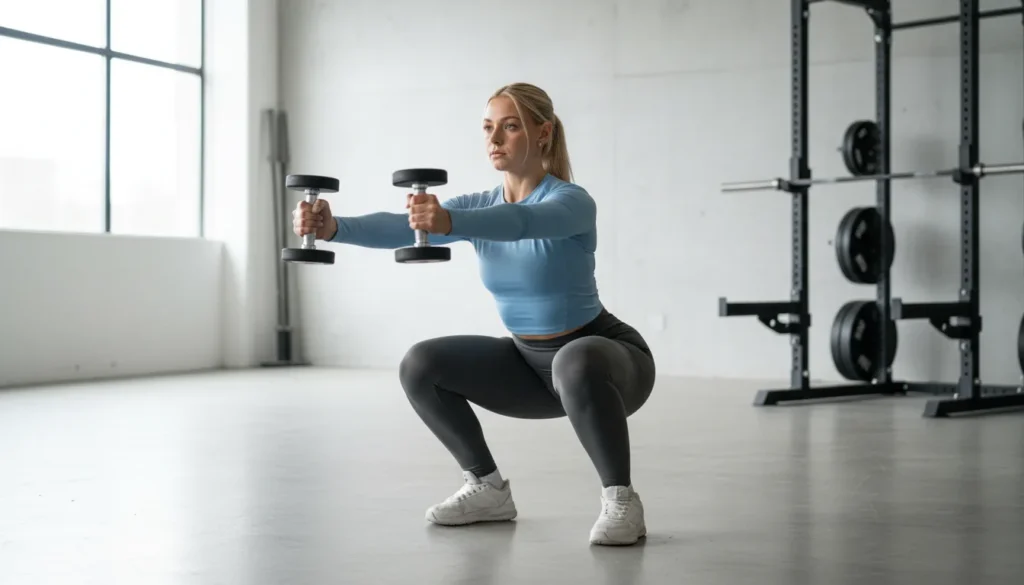
This is the dumbbell equivalent of a barbell front squat. You hold one dumbbell in each hand at shoulder height, palms facing inward (neutral grip), elbows driving up and forward so the dumbbells rest on your shoulders near your clavicles.
Getting the dumbbells into position requires some thought, particularly as the weights get heavier. On lighter loads, a hammer curl brings them to shoulder height cleanly. On heavier loads, a dumbbell clean — an explosive hip-drive movement — is the proper technique. Legion Athletics describes the endpoint clearly: as the dumbbells reach shoulder height, the ends nearest your thumbs rest on your shoulders, and you push your elbows up and out to complete the rack.
What it does biomechanically: The front rack places more demand on your upper back and thoracic spine than the goblet hold, because two independent weights require active muscular effort to stabilize at shoulder height throughout the entire set. Your core works harder. Your upper back works harder. The load distribution is also more similar to a barbell front squat than any other dumbbell variation.
This is the position that limits upper body output before lower body output — a common complaint with any front-loaded squat. Your arms, shoulders, and upper back may give out before your legs have reached their capacity.
Who it suits best: Intermediate to advanced lifters who have outgrown the goblet squat’s load ceiling, people training without a barbell or squat rack, and athletes who want quad-dominant squatting without barbell wrist and shoulder mobility requirements.
What can go wrong: Dropping the elbows mid-set causes the dumbbells to fall forward, which creates an immediate spine flexion response that rounds the upper back. High elbows throughout — that cue matters. Knee valgus (caving inward) is also common as loads increase; drive the knees out in the direction your toes point throughout the descent.
Muscles targeted: Quadriceps (primary), glutes, hamstrings, core, upper back, and front deltoids. More comprehensive than the goblet variation in upper body demand.
4. Zercher Position (Dumbbells in the Elbow Crook)
Hold one dumbbell (or two kettlebells/dumbbells) in the crook of your elbows, cradled in your forearms at stomach height. This is the dumbbell adaptation of the barbell Zercher squat, a movement originally developed by 1930s strongman Ed Zercher, who reportedly invented it because he didn’t have a squat rack and had to lift from the floor.
The position looks strange. It is strange. It also works exceptionally well for a specific set of goals.
What it does biomechanically: Loading at stomach height — lower on the torso than the goblet or front rack position — places the load’s center of mass at roughly the same height as the natural body position in a deep squat. This makes the Zercher squat unusually natural-feeling at the bottom, even with substantial weight. The anterior loading keeps the torso upright, and because the elbows act as the load-bearing surface, shoulder and wrist mobility requirements are minimal. REP Fitness notes that anterior loading in this position makes it easier to maintain balance and reduces lower back stress compared to posterior loading.
The major catch: the elbow crook is not a comfortable place to hold weight. The bone-to-bar contact creates real discomfort, especially for beginners. Padding the implement helps. With dumbbells, the discomfort is somewhat reduced compared to a barbell because the dumbbell’s head rests across the forearm rather than a round steel bar pressing directly into the ulna.
Who it suits best: Lifters who lack the shoulder or wrist mobility for a front rack, people who want deep quad and core training without barbell access, and advanced athletes looking for a novel stimulus. It’s popular in strongman and CrossFit training communities because the loading pattern transfers directly to real-world carry events.
What can go wrong: Forward lean under heavier loads rounds the lower back. Keep relative intensity moderate — staying below about 85% of your max effort for this variation is sensible advice, because the lower back becomes a significant weak point if technique breaks down.
Muscles targeted: Quadriceps (heavily), upper back, core, biceps, and anterior deltoids. The biceps get more work here than in any other squat variation because they’re actively holding the load throughout.
Comparing the Four Positions
| Position | Primary Muscles | Torso Angle | Skill Level | Load Potential |
|---|---|---|---|---|
| At Sides | Glutes, hamstrings | Forward lean | Beginner | High (grip limits) |
| Goblet (single DB) | Quads, core | Upright | Beginner–Intermediate | Moderate |
| Front Rack (double DB) | Quads, upper back, core | Very upright | Intermediate–Advanced | High |
| Zercher (elbow crook) | Quads, biceps, core | Upright | Intermediate–Advanced | Moderate |
How Dumbbell Position Affects Specific Goals
For Quadriceps Development
Front-loaded positions — goblet, front rack, and Zercher — all prioritize the quads more than holding dumbbells at the sides. The upright torso these positions enforce means your knees travel further forward during the descent, which is exactly the mechanics that bias quadriceps activation. If quad hypertrophy is the priority, the double dumbbell front rack offers the best combination of quad bias and load potential.
For Glute and Hamstring Development
The at-sides position preserves the natural forward lean associated with greater hip hinge involvement, which keeps the glutes and hamstrings in a mechanically advantageous position. For anyone whose primary goal is posterior chain development, holding dumbbells at the sides or incorporating sumo stance variations with a goblet hold achieves this better than a strict front rack.
For Lower Back Health
Any front-loaded position reduces compressive spinal load relative to a back squat. Research on dumbbell loading versus barbell loading finds that dumbbell positions generally permit more natural weight distribution and reduce peak joint forces, particularly for lifters with limited experience. People with existing lower back sensitivities tend to tolerate goblet squats and at-sides dumbbell squats better than barbell variations.
For Core Strength
Front-loaded positions generate the highest core demand. The goblet squat requires the abs, obliques, and lower back to resist the forward-pulling weight throughout the movement. The Zercher variation arguably demands the most core engagement of any dumbbell squat, because the low load position requires constant anti-flexion work through the lumbar spine to prevent rounding.
For Beginners
The goblet squat is the standard starting point for good reason — it’s mechanically self-correcting, doesn’t require wrist or shoulder mobility, and teaches the upright torso position that transfers to more complex squat patterns later. Start here.
Common Technique Errors by Position
At-Sides Errors
- Dumbbells drifting forward, loading the toes instead of midfoot
- Excessive forward lean that should prompt a transition to a front-loaded variation
- Gripping too hard and tensing the neck and upper traps unnecessarily
Goblet Errors
- Elbows rising forward instead of staying tucked down
- The dumbbell sitting too far from the body, increasing moment arm
- Cutting depth short because the position feels unstable at bottom (usually a core bracing issue, not a mobility one)
Front Rack Errors
- Elbows dropping mid-set, causing the dumbbells to slide off the shoulders
- Wrist rotation that creates discomfort — keep a neutral palm-inward grip
- Rising onto the toes due to ankle mobility restriction; a small heel elevation plate can resolve this temporarily while ankle mobility improves
Zercher Errors
- Allowing forward lean and lower back rounding under heavy load
- Gripping the dumbbell too aggressively and creating forearm cramping rather than letting the elbow crook bear the load passively
- Going too heavy too soon — discomfort should be manageable, not distracting
Which Position Should You Use?
If you’re new to squatting with dumbbells: Start with the goblet position. Learn to keep your torso upright and your knees tracking over your toes. Spend several weeks here before moving on.
If you’ve outgrown the goblet squat’s load ceiling: Transition to the double dumbbell front rack. This keeps the same front-loaded mechanics with substantially more load potential. Your upper back and core will be challenged in new ways initially — expect that adaptation period.
If you’re training primarily for glutes and hamstrings: Hold the dumbbells at your sides and focus on controlling the descent with minimal forward lean. Consider a sumo stance (wider feet, toes turned out further) to emphasize the hip abductors and adductors.
If you have limited shoulder or wrist mobility: The Zercher position bypasses both of those common restrictions and provides a legitimately front-loaded squat stimulus without the wrist-intensive front rack position.
If your goal is comprehensive lower body development: Rotate through positions across different training blocks. Each one stresses the muscles in slightly different proportions, and that variety pays dividends over months of consistent training.
Programming Dumbbell Squat Positions
Strength Focus (3–6 reps): Front rack position with the heaviest load you can manage while maintaining an upright torso and full depth. Clean the weights to your shoulders before each set.
Hypertrophy Focus (8–12 reps): Goblet or front rack with moderate load and controlled tempo — 3 seconds down, brief pause at the bottom, 2 seconds up. The time under tension at these rep ranges drives muscle growth effectively.
Muscular Endurance (12–20 reps): Goblet position or at-sides position with lighter load. These rep ranges work well in circuits combined with upper body or hinge movements.
Movement Quality / Corrective Work: Goblet squat with a light dumbbell for sets of 10–15, focusing on the quality of the movement pattern rather than load. Many coaches use this as a daily movement warm-up for clients who need to rebuild or refine their squat mechanics.
Special Considerations
Ankle Mobility and Heel Elevation
Limited ankle dorsiflexion (the ability to bring the shin forward over the foot) shows up as heel rise during the descent, regardless of which dumbbell position you’re using. A small plate under the heels — 1–2 cm of elevation — temporarily reduces this demand and allows a more upright torso and greater depth while ankle mobility is being developed through dedicated stretching work. Breaking Muscle’s guide to dumbbell front squats notes this as a legitimate modification for anyone who struggles to maintain a flat foot at the bottom.
Grip Fatigue
Grip often becomes the limiting factor before legs do, particularly on higher-rep sets holding two dumbbells. Chalk, if your gym allows it, helps. Wrist wraps can reduce discomfort in the front rack position. Some lifters find that fat-grip dumbbells accelerate grip strength development, making this less of a problem long-term.
Progressing When You’ve Maxed Out Available Dumbbells
Most commercial gyms cap out at 100–120 lbs on their dumbbells. For stronger lifters, this represents a genuine ceiling on the goblet squat position. At that point, either the double dumbbell front rack (more load, more demanding) or a transition to barbell variations keeps the progressive overload continuing. Resistance bands added to a dumbbell squat also add accommodating resistance, making the top portion of the movement harder without changing the peak floor load — a legitimate technique for lifters who’ve exhausted standard load progression.
Frequently Asked Questions (FAQs)
Is it better to hold one dumbbell or two when squatting?
It depends on what you’re training. A single dumbbell in the goblet position is better for learning form and building the pattern with an upright torso, particularly for beginners. Two dumbbells in the front rack position allow heavier loading and more upper back involvement, making it better for building strength once you’ve mastered the goblet variation.
Should I hold the dumbbell close to my chest or away from my body in a goblet squat?
Close to your body, always. The moment arm is shorter when the weight is closer to your torso, which reduces the strain on your spine and makes the hold more sustainable. The dumbbell should sit under your chin with your elbows pointing down, not reaching out in front of you.
What’s the difference between a goblet squat and a dumbbell front squat?
In the goblet squat, you hold a single dumbbell at chest height between both hands, elbows tucked down. In the dumbbell front squat, you hold one dumbbell in each hand at shoulder height with elbows up, mimicking the barbell front squat rack position. The front squat places greater demand on the upper back and allows heavier loading over time, while the goblet squat is easier to set up and better suited to beginners.
Can I do a Zercher-style squat with dumbbells instead of a barbell?
Yes. Cradle one larger dumbbell or two smaller dumbbells/kettlebells in the crook of your elbows, holding them at stomach height. This works well for anyone who lacks the shoulder or wrist mobility for the front rack position. The load potential is lower than a barbell Zercher, but the stimulus for the quads, core, and upper back is similar.
Where should I hold dumbbells for a sumo squat?
The goblet position — single dumbbell at chest height — is standard for a sumo squat variation. The wider stance and outward-turned toes emphasize the glutes and hip adductors, while the front-loaded dumbbell keeps the torso upright. You can also hold the dumbbell at your sides between your legs in a plie/sumo squat, which is common in group fitness settings and works well for higher-rep training.
Does dumbbell squat position affect lower back pain?
Yes. Front-loaded positions (goblet, front rack, Zercher) generally reduce lower back stress compared to back-loaded barbell squats because the upright torso decreases lumbar shear forces. Holding dumbbells at the sides preserves more forward lean, which can increase lower back demand. Anyone with lower back sensitivities should prioritize front-loaded dumbbell positions and focus on core bracing throughout the movement.
How do I get heavy dumbbells to shoulder height for front rack squats?
For lighter dumbbells, a standard hammer curl brings them up cleanly. For heavier weights, use a dumbbell clean — a hip-drive movement where you explosively extend your hips and knees, using that momentum to bring the dumbbells to shoulder height. Practice the clean with light weights before adding load, because poor technique under heavy loads increases shoulder and wrist injury risk.
Should beginners use dumbbells at the sides or goblet squats?
Goblet squats. The at-sides position allows poor squat patterns to go uncorrected — forward lean, heels rising, knees caving — because there’s no counterbalance effect from the weight. The goblet position is more forgiving of mobility restrictions and teaches the correct mechanics more efficiently. Most beginners can feel the difference in their torso position immediately after switching from at-sides to goblet.
How heavy should the dumbbell be for a goblet squat?
Start with a weight that allows 10–12 clean reps with the torso upright and depth at or below parallel. For most beginners, this is somewhere between 10–25 lbs. Progression should come through adding 5 lbs at a time — goblet squats feel deceptively easy at light loads, but a well-executed set with a heavy dumbbell (50 lbs or more) is genuinely hard work for most people.
Can dumbbell squats replace barbell squats?
For most non-competitive lifters training for general strength and muscle development, dumbbell squats in the front rack position are a legitimate substitute for barbell squats. They build the same muscles, develop similar patterns, and are considerably more accessible. The main limitation is load — once you’ve progressed past what the available dumbbells can provide, a barbell is the next step. For strength sports competition, there’s no substitute for the barbell.
In conclusion
The best place to hold dumbbells when squatting depends on what you’re trying to accomplish and where you are in your training. There is no universally superior position.
Beginners should start with the goblet position because it corrects form problems automatically and teaches the upright torso position that transfers to everything else. Intermediate lifters should add the double dumbbell front rack once they’ve built the core and upper back strength to maintain the position under heavier loads. The at-sides position serves those chasing posterior chain development. The Zercher variation is worth adding when mobility or variety becomes a priority.
What ties all four together is this: keep the weight close to your body, brace your core before every rep, and track your knees over your toes throughout the descent. Those three cues hold regardless of which position you’re using.
Pick the position that matches your current goal. Get strong in it. Then decide whether to stay there or add another tool.