If you ask ten gym-goers what angle they use for the incline dumbbell press, you will probably get ten different answers — and half of them will be wrong for their actual goal. The angle debate sounds trivial. It is not. Set the bench too high and you are effectively doing a front-delt raise with dumbbells. Set it too low and you are barely distinguishing the movement from a flat press. Get it right and you have one of the most efficient upper chest builders in existence.
Why Bench Angle Matters More Than Most Lifters Think
The pectoralis major is not a single uniform slab of muscle. It has three distinct portions: the clavicular head (upper chest), the sternocostal head (middle and lower chest), and the abdominal head. Each portion responds differently to pressing angles because each has a slightly different fiber orientation relative to your torso.
When you press on a flat bench, the sternocostal head does the bulk of the work. Tilt the bench upward and you progressively shift the line of pull toward the clavicular head. The question is how far to tilt it before the anterior deltoid takes over — and that is where the real debate lies.
Your front delt and your upper chest fibers run close to each other anatomically. Because the anterior deltoid is a strong horizontal pusher, it is eager to contribute any time the pressing angle gets steep. This is not a problem on paper, but in practice it means the upper chest can get outcompeted by the shoulder, leaving you with a well-developed front delt and a flat upper chest.
Getting the angle right is essentially about threading a needle: steep enough to bias the clavicular head, but not so steep that the front delt dominates.
What the Research Actually Says
The 2016 Lauver Study
Published in the Journal of Strength and Conditioning Research, this study tested four angles: -15 degrees, 0 degrees, 30 degrees, and 45 degrees.
The results showed that a 30-degree incline was more beneficial than 45 degrees because both angles produced equal upper pectoralis activation, but 30 degrees also generated greater lower pectoralis activation. In practical terms, 30 degrees gave you more total chest work for the same upper chest stimulus.
The Trebs Study (Chest Press Machine)
This electromyography analysis found that activation of the clavicular head of the pectoralis major was significantly greater at 44 degrees compared to 0 degrees, and also significantly greater at 44 degrees compared to 28 degrees. Interestingly, 56 degrees did not outperform 44 degrees for clavicular activation — suggesting there is a ceiling around the low-to-mid 40s before the movement becomes shoulder-dominant.
The European Journal of Sport Sciences Study
This study found that performing the incline barbell bench press at an angle above 32 degrees leads to significantly higher neuromuscular activation of the clavicular head of the pectoralis major, with 43 degrees being the most beneficial angle tested.
What the Research Agrees On
When you read these studies together, two things are consistent:
- Angles between 30 and 45 degrees produce strong upper chest activation.
- Going above 45-50 degrees shifts load toward the anterior deltoid without further increasing clavicular pec activation.
Flat bench press produces the highest EMG signal for the sternocostal head of the pectoralis major, while inclining the bench to 44 degrees tends to produce the greatest EMG amplitude within the clavicular portion.
There is no study showing that 60 degrees outperforms 45 degrees for chest development. None.
The Best Angle for Incline Dumbbell Press
15 to 20 Degrees: Low Incline
At this angle the exercise still resembles a flat press more than a true incline movement. You will feel your middle chest more than your upper chest, and the stretch at the bottom of the movement is excellent.
This range is useful if you have shoulder impingement issues that make steeper inclines uncomfortable, or if your middle chest lags behind your upper chest. Some coaches use low-incline pressing as a bridge variation between flat and incline work. It is not ideal as your primary upper chest movement, but it serves a purpose.
30 Degrees: The Research-Backed Default
Research shows that the correct angle for the incline dumbbell press to target the upper chest for muscle growth is 30 degrees from flat. Most strength coaches who follow the evidence land here.
At 30 degrees, the clavicular head is meaningfully recruited while the sternocostal head still participates. Your front delts assist without dominating. The stretch at the bottom is good. You can typically handle reasonable load. For most people with no shoulder issues and a goal of upper chest development, 30 degrees is the right starting point.
Many coaches consider 30 degrees the sweet spot because it balances upper chest recruitment with manageable shoulder involvement.
45 Degrees: Still Productive, With Caveats
At 45 degrees you are still in effective territory for clavicular head activation. The front delt contribution is noticeably higher than at 30 degrees, but the upper chest is still working hard. If 30 degrees does not feel right for your body — whether that is due to bench design, shoulder anatomy, or simply where you feel the exercise most — 45 degrees is a legitimate alternative.
Higher and lower angles are both effective for the incline press; lowering the angle emphasizes the lower chest while increasing the angle emphasizes the shoulders. Some lifters with longer clavicles or particular shoulder structures actually feel a stronger chest contraction at 45 degrees than at 30. Individual anatomy matters.
60 Degrees: Primarily a Shoulder Exercise
Once you get to 60 degrees, the movement resembles an incline shoulder press more than a chest exercise. The anterior deltoid is the dominant mover, and most of the mechanical advantage for the pectoralis major is lost.
Setting the flat bench to 60 degrees is a bench angle mistake if your goal is upper chest development, because the upper chest fibers are not being trained as the primary mover.
This is not to say 60 degrees is useless — if you want anterior deltoid work, it is fine. But if you are doing it because you think more angle means more upper chest, you are mistaken.
Angle Comparison at a Glance
| Bench Angle | Primary Target | Front Delt Involvement | Best For |
|---|---|---|---|
| 15-20 degrees | Middle/upper chest | Low | Shoulder-sensitive lifters, variety |
| 30 degrees | Upper chest (clavicular head) | Moderate | Most lifters, primary upper chest work |
| 45 degrees | Upper chest + front delt | Moderate-high | Lifters who feel more at this angle |
| 60 degrees | Anterior deltoid | High | Shoulder training, not ideal for chest |
| 90 degrees | Anterior deltoid | Dominant | Shoulder press |
Dumbbells vs. Barbell: Does the Angle Change?
The angle recommendations above come primarily from barbell studies, but they translate reasonably well to dumbbell pressing. There are a few meaningful differences worth knowing.
Unlike the barbell version, using dumbbells allows for a more natural range of motion, greater pectoral stretch at the bottom position, and helps identify and correct strength imbalances between sides. It is also generally more shoulder-friendly for many lifters.
Because dumbbells allow each arm to move independently, you are not locked into a fixed bar path. This means your shoulders can settle into a more natural position at any given angle. The result is that some lifters find they tolerate steeper angles better with dumbbells than with a barbell.
Studies have shown comparable strength improvements when comparing exercises using barbells and dumbbells for bench pressing, with the added benefits of achieving a wider range of motion and engaging in movements that work each side of the body independently.
The practical takeaway: start your incline work at 30 degrees regardless of which tool you use. If barbell incline pressing at 30 degrees bothers your shoulders, try dumbbells at the same angle before you start adjusting the bench higher.
How to Actually Perform the Incline Dumbbell Press with Good Form
Getting the angle right is step one. Setting up and executing the lift properly is what converts the right angle into actual muscle growth.
Setup
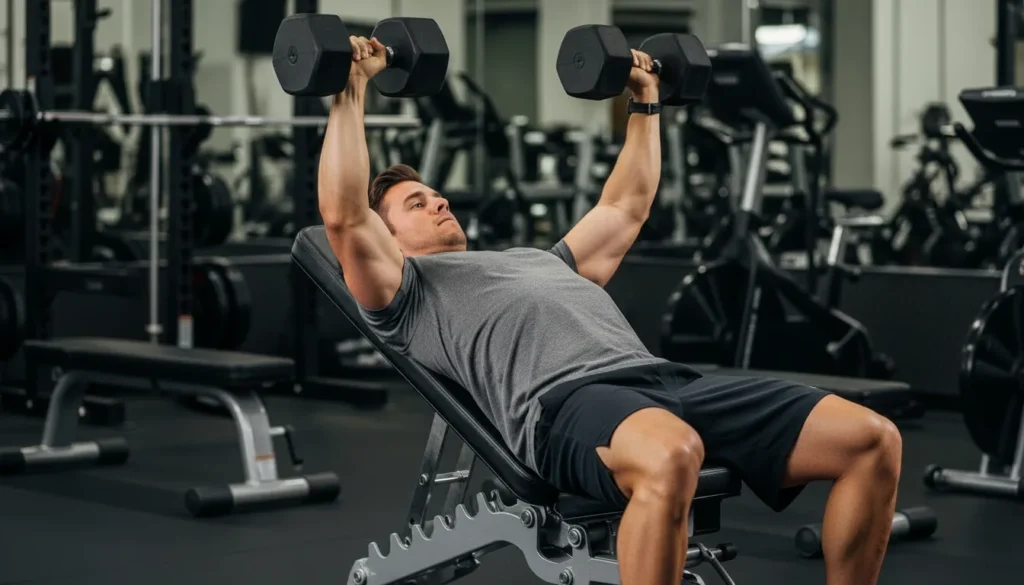
Set the bench to 30 degrees (or your chosen working angle). Sit on the bench and rest the dumbbells on your thighs before lying back — trying to maneuver heavy dumbbells into position after you are already lying flat is a common way to strain a shoulder.
As you lie back, use your thighs to help kick the dumbbells up to your chest level. Plant your feet flat on the floor. Do not let your heels come up.
Shoulder Position
Actively pull your shoulder blades back into retraction and down into depression before you press anything. Think about pinching them together and tucking them toward your back pockets. This protects your shoulders and maximizes chest engagement.
This is the step most people skip, and it is arguably more important than the angle itself. If your shoulder blades are not retracted and depressed, your front delt will dominate no matter what angle you set the bench to.
The Press
Hold the dumbbells at chest height with palms facing forward (pronated grip). Your elbows should be at roughly 45 to 75 degrees from your torso — neither flared straight out to your sides nor tucked completely against your body.
Push the dumbbells upward and slightly inward, following a path toward the centerline above your upper chest. At the top, extend your arms until nearly straight but avoid aggressively locking out your elbows. The dumbbells should be close together at the top without touching.
The Eccentric
Lower the dumbbells with control. Taking two to three seconds on the way down improves muscle activation and reduces injury risk. Lower until the dumbbells are roughly in line with your upper chest, allowing a full stretch in the pectoral.
Breathe out as you press the dumbbells upward and breathe in as you slowly return them to the starting position beside your shoulders.
Wrist Position
Keep your wrists straight and in line with your forearms. Bending them backward during the upward motion causes unnecessary strain and predisposes the joint to injury over time. This is easy to ignore with lighter weights and easy to regret with heavier ones.
Common Mistakes That Undermine Results
Using Too High an Angle
This is the single most common mistake. Walk into any commercial gym and you will see people incline pressing at 60 to 70 degrees, wondering why they never develop their upper chest. The bench is effectively converting a chest exercise into a shoulder exercise.
Letting the Shoulder Blades Protract
If your shoulder blades slide forward (protraction) as you press, your chest disengages and your front delt takes over. This happens when lifters go too heavy or rush the setup. Check your shoulder position every single set before you unrack the weights.
Elbow Flare
Flaring your elbows too far out places your shoulders in a weaker and more compromised position during the press. Tucking them in more keeps them safer and maximizes power output.
Going Too Heavy Too Soon
A common mistake is using too much weight because many trainees reason that if they can flat press a certain amount, they should lift it on the incline press too. Start with 70 to 80 percent of what you flat press and adjust from there, since using too much weight cuts range of motion short and puts you at risk of injury.
Bouncing at the Bottom
Using momentum at the bottom position by bouncing the dumbbells off your chest removes the stretch stimulus from the pec and shifts load to the tendons and connective tissue. The eccentric is where a significant portion of muscle damage and subsequent growth stimulus occurs — shortchanging it shortchanges your results.
Overarching the Lower Back
Over-arching the back puts you at risk of back strain and may involve unintended muscles. Maintain the natural arch without increasing it; pushing your back aggressively into the bench causes your shoulders to roll forward.
Grip Variations and Their Effect
Standard Pronated Grip (Palms Forward)
This is the default for incline dumbbell pressing. It recruits the pectoralis major and anterior deltoid most directly and allows for the most natural pressing path.
Neutral Grip (Palms Facing Each Other)
Performing the press with palms facing each other can reduce shoulder stress and increase triceps activation. Some lifters with rotator cuff irritation find the neutral grip significantly more comfortable on incline work. The chest still gets trained, just with a slightly different emphasis.
Rotating Grip
Rotating the wrists from a neutral position at the bottom to a pronated position at the top during the press can enhance activation of different chest fibers. This technique is not well studied but has anecdotal support among experienced lifters. Worth experimenting with if you have been stagnant.
Muscles Worked by the Incline Dumbbell Press
Pectoralis Major (Clavicular Head): The primary target. This is the upper chest muscle running from your clavicle to your upper arm bone. It is often underdeveloped relative to the sternocostal portion in people who exclusively flat press.
Anterior Deltoid: The front portion of the shoulder. Always involved in pressing movements, more so as angle increases. At 30 degrees it assists; at 60 degrees it leads.
Triceps Brachii: Responsible for extending the elbow during the press. Their contribution increases as you near lockout.
Rotator Cuff Muscles: The free-range motion of dumbbells requires rotator cuff involvement for stabilization, giving the rotator cuffs a meaningful workout that barbell pressing does not fully replicate.
Core and Stabilizers: Pressing unilaterally — one dumbbell at a time — increases core demand substantially. Even bilateral dumbbell pressing demands more stabilization than a barbell because each arm moves independently.
Programming the Incline Dumbbell Press
Where It Fits in a Chest Day
Most lifters benefit from programming the incline dumbbell press as either the first or second movement on chest day. If upper chest development is a specific weakness, put it first when you are freshest. If you are prioritizing overall chest mass, flat pressing first and incline second is a sensible structure.
Sets and Reps
For hypertrophy, 3 to 4 sets of 8 to 12 repetitions at a moderate load is well supported by the evidence. If upper chest lagging is a problem, adding a fourth set or a fifth set on incline movements can address it.
Tempo matters more than most people acknowledge. A 2 to 3 second eccentric with a brief pause at the bottom before pressing will produce more muscle stimulus than fast, bouncy reps with the same weight.
Progressive Overload
Track your weights. If you are doing 3 sets of 10 at a given weight, your target is to either add a rep to each set or add a small amount of weight the following week. Without this progression over months, the incline dumbbell press will produce results initially but plateau quickly.
Frequency
Training the incline press twice per week with adequate recovery between sessions produces faster upper chest development than once per week. This could mean chest day on Monday and Thursday, with incline pressing featured in both sessions, or you can rotate the angle — 30 degrees one session, 45 degrees the next — to slightly vary the stimulus.
The Anatomy Argument: One Angle Does Not Fit Everyone
The 30-degree recommendation is the best default, but it is not universally optimal. Body structure genuinely affects which angle feels most like a chest exercise.
Lifters with longer clavicles sometimes feel the upper chest more at 35 to 40 degrees. Lifters with particularly strong front delts may find that their anterior deltoid fires before their chest regardless of angle, which is a muscle activation issue as much as an angle issue — pre-activating the chest with a set of cable flyes before pressing can help.
If you have been pressing at 30 degrees for months and never feel your upper chest working, do not just blindly raise the angle. Instead, check your shoulder blade position first. Try slow, controlled reps with lighter weight and focus on the muscle itself. Only after addressing those factors should you experiment with angle.
The point is: start at 30 degrees, stay there long enough to adapt to the movement pattern, and adjust based on what your body tells you — not based on what looks most impressive in the gym mirror.
Advanced Techniques to Maximize Upper Chest Activation
Pre-Exhaustion
Performing a set of incline dumbbell flyes or cable crossovers targeting the upper chest before pressing can improve mind-muscle connection during the press. This is not necessary for most people but can help if the front delt consistently takes over.
Pause Reps
Pausing for one second at the bottom of the rep removes momentum entirely and forces the chest to work through the full range of motion from a dead stop. This technique is particularly useful for building the stretch-position strength of the clavicular head.
Single-Arm Variation
Pressing one dumbbell at a time increases core activation and allows greater focus on each side independently. It also makes it easy to notice whether one side is weaker or moving differently, which is useful information if you have any shoulder asymmetry.
Slow Eccentrics
Lowering the dumbbells slowly over 3 to 4 seconds before pressing improves time under tension for better hypertrophy. This approach reduces the load you can handle but typically increases muscle soreness and growth stimulus, particularly in the stretch position.
Frequently Asked Questions (FAQs)
Is 30 degrees or 45 degrees better for incline dumbbell press?
For most people, 30 degrees is the better option for upper chest development. At 30 degrees you get strong clavicular head activation with less front delt takeover than at 45. That said, some lifters with particular anatomical proportions feel a stronger chest contraction at 45. Start at 30, and only move to 45 if the lower angle genuinely does not feel like a chest exercise after several weeks.
What happens if the incline is too steep?
Once you pass roughly 50 to 60 degrees, the movement transitions into an anterior deltoid exercise. The pectoralis major clavicular head is no longer in an advantageous mechanical position, and the front shoulder takes over as the primary mover. You will still get a pressing stimulus, but you will not be efficiently developing your upper chest.
Can I build my upper chest with just a flat bench press?
The flat bench press primarily works the sternocostal head of the pectoralis major. While the clavicular head does assist, it is not the primary driver at 0 degrees. People who exclusively flat press often develop a well-defined middle and lower chest with an underdeveloped upper chest. Incline pressing is necessary if upper chest development is your goal.
Should beginners use incline dumbbell press?
Yes. The incline dumbbell press is appropriate for beginners with no shoulder injuries. Start with light weight, focus on the setup — especially the scapular retraction and depression — and learn the movement pattern before adding load. Beginners will often need to use a weight significantly lighter than they expect.
How much less should I lift on incline compared to flat press?
A reasonable starting point is 70 to 80 percent of what you flat press on the incline, adjusting from there based on how the movement feels. The incline position is mechanically less efficient for most people, and the additional stabilization demand of dumbbells means you will typically handle less than a barbell incline press as well.
Does the incline dumbbell press work the front delts too much?
At steeper angles, yes. At 30 degrees, front delt involvement is manageable — it assists without dominating. The bigger contributor to front delt takeover is poor shoulder blade position, not the angle itself. Retract and depress your scapulae before every set and the front delt issue largely resolves itself.
Is the incline dumbbell press safe for people with shoulder problems?
It depends on the nature of the injury. Many people with mild rotator cuff irritation actually tolerate incline dumbbell pressing better than flat pressing because the incline reduces the range of motion at the bottom where shoulder impingement typically occurs. The neutral grip variation is also gentler. That said, always consult a medical professional or qualified physical therapist if you have a diagnosed shoulder condition before loading up.
How do I know if I am feeling the incline press in my chest versus my shoulders?
At the top of the movement, try squeezing your chest together. If you feel the contraction in your upper chest (below the collarbone), the exercise is doing its job. If you feel most of the fatigue at the front of your shoulder, your bench is likely too high, your shoulder blades are protracting, or your elbows are flared too far out.
How often should I do the incline dumbbell press?
Twice per week with 48 to 72 hours of recovery between sessions works well for most natural trainees focused on hypertrophy. More than twice per week rarely adds benefit for intermediate and advanced lifters; less than once per week is usually insufficient for meaningful upper chest development.
Can I replace the barbell incline bench press with the dumbbell version?
For most hypertrophy goals, yes. Dumbbells offer a greater range of motion, better shoulder tracking, and address side-to-side imbalances. The barbell version allows heavier absolute loads and may be preferable in strength-focused training blocks. For general upper chest development, dumbbells are at least equally effective and often more joint-friendly.
In conclusion
The best angle for the incline dumbbell press is 30 degrees for the majority of lifters, based on the current weight of EMG evidence. This angle delivers meaningful clavicular head activation while keeping the front delt in an assisting rather than dominant role.
That said, individual anatomy is real. If 30 degrees does not feel like a chest exercise after you have nailed your form, moving up to 35 or 40 degrees is a reasonable adjustment. What you should not do is jump to 60 degrees because it feels harder. Harder does not always mean more productive for the target muscle.
The other variables matter just as much as the angle. Shoulder blade position, grip, tempo, progressive overload, and training frequency all influence how much upper chest you ultimately develop. The angle is a starting point, not the whole answer.
Set the bench to 30 degrees, master the form, train with progressive intent, and your upper chest will develop. Everything else is fine-tuning.
Want to choose the most practical dumbbells for your home gym? Check out Why Hex Dumbbells Are the Best to learn how their stability, durability, and versatility make them a top choice for strength training.