The dumbbell pullover is one of the few exercises that genuinely confuses people — not because it’s hard to execute, but because nobody can agree on what it actually does. If you’re trying to learn how to do a dumbbell pullover correctly, you’re not alone.
Is dumbbell pullover a chest exercise? A back exercise? Should it go at the end of your push day, or is it secretly a pull movement?
The short answer: it works both, the debate is largely overstated, and the form mistakes most people make are costing them real results.
What Is the Dumbbell Pullover?
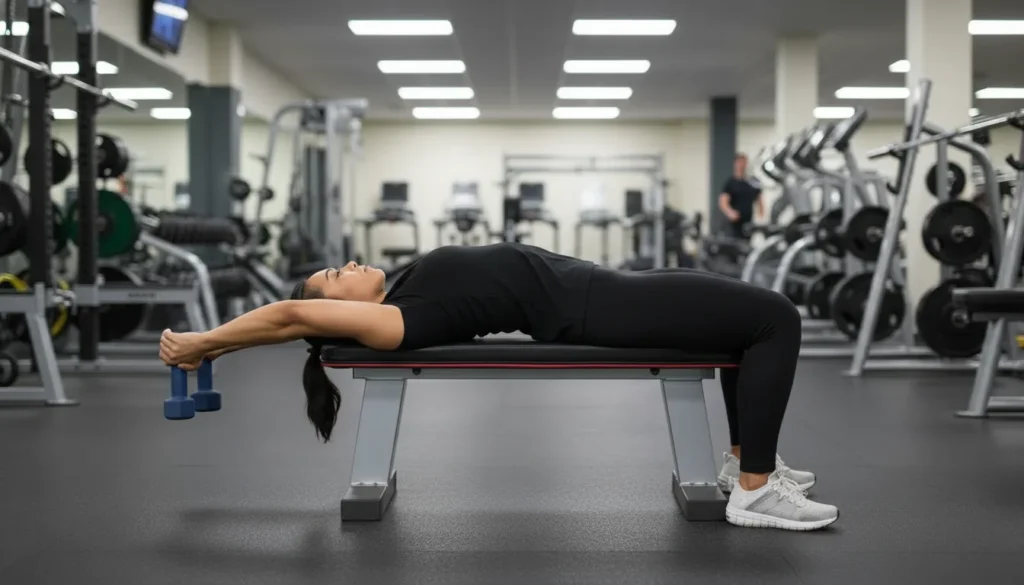
The dumbbell pullover is an upper-body compound exercise performed lying on a flat bench, holding a single dumbbell with both hands and moving it in a controlled arc from above your chest to behind your head and back. The movement is driven primarily by shoulder flexion and extension at the glenohumeral joint, pulling multiple large muscle groups through a long range of motion simultaneously.
Both the pectoralis major and latissimus dorsi are active during the movement. The question of which dominates depends on your grip, elbow angle, bench setup, and where your attention goes during each rep.
Muscles Worked During the Dumbbell Pullover
Primary Muscles
Pectoralis Major (Chest) The chest is the primary driver as you bring the dumbbell back over your torso. Research shows higher pec activation than lats in most setups, especially targeting the lower and sternal fibers due to shoulder extension.
Latissimus Dorsi (Back) The lats are heavily stretched at the bottom and help initiate the pull. Keeping elbows slightly tucked and focusing on pulling through the elbows increases lat involvement.
Secondary Muscles
Triceps Long Head The long head of the triceps crosses the shoulder joint. Research consistently shows notable triceps activation during the pullover, particularly when the elbows are kept relatively extended throughout the rep.
Serratus Anterior This muscle, which runs along the side of your ribcage and under your shoulder blade, works hard to keep the scapula stable and pressed against the ribcage during the movement. Weakness here is actually one of the reasons people feel pinching or instability at the shoulder during pullovers.
Posterior Deltoids and Teres Major These shoulder muscles assist in the pulling motion and play a stabilizing role, particularly as the dumbbell descends and the shoulder joint reaches end-range flexion.
Core and Intercostals With proper breathing, the intercostal muscles between your ribs get a meaningful stretch. Your abdominals and obliques engage to prevent the lower back from excessively arching as the weight goes overhead.
How to Do a Dumbbell Pullover: Step-by-Step
Setup and Starting Position
Sit at the end of a flat bench with the dumbbell standing upright on your thighs. Carefully lie back along the bench, bringing the dumbbell with you, until your upper back and shoulders are fully supported and your head is near the end of the bench. Your feet should be flat on the floor, hip-width apart, with your knees bent at roughly 90 degrees. Your hips can stay on the bench, or drop slightly below bench level — more on that in the variation section.
Grip the dumbbell by cupping both hands under the upper plate, thumbs and forefingers forming a diamond shape around the handle. Your palms press flat against the underside of the top plate. Arms should be extended above your chest, with a slight bend at the elbows — maybe 10 to 15 degrees. Do not lock your elbows.
This is your starting position.
The Lowering Phase (Eccentric)
Take a slow, controlled breath in through your nose as you begin to lower the dumbbell back in an arc over your head. The movement is arc-shaped — imagine drawing a half-circle with the dumbbell from above your chest down toward the floor behind you.
Move slowly. A 3-to-4-second descent is ideal. Feel your chest and lats stretch as the weight descends. At the bottom of the movement, your upper arms should be roughly parallel to the floor, or your biceps near your ears. You should feel a solid stretch through the chest and lats — not a sharp pain at the shoulder.
The lower back may lift slightly as the weight descends, which is fine within reason. If it arches dramatically, the weight is too heavy or your core is disengaged.
The Bottom Position
Pause briefly at the bottom — just long enough to lose any momentum. This is where you earn the stretch and where most people rush. Resisting the urge to bounce out of the bottom is what separates a good pullover from a mediocre one.
The Lifting Phase (Concentric)
Exhale and pull the dumbbell back along the same arc to the starting position above your chest. As you pull, think about squeezing your chest and lats simultaneously rather than just lifting the weight with your arms. The movement should take 1 to 2 seconds on the way up.
When the dumbbell returns to the starting position above your chest, that is one complete repetition.
Recommended Sets, Reps, and Tempo
| Goal | Sets | Reps | Tempo (Eccentric/Concentric) |
|---|---|---|---|
| Hypertrophy (muscle building) | 3–4 | 10–15 | 3-1-2 |
| Strength development | 3–4 | 6–10 | 2-1-2 |
| Mobility and warm-up | 2–3 | 12–20 | 3-0-2 |
Dumbbell Pullover Variations
Bent-Arm Dumbbell Pullover
Increasing the bend in your elbows to roughly 45–60 degrees reduces the leverage and stress on the shoulder joint, making this the go-to variation for beginners or anyone with existing shoulder discomfort. The reduced range of motion slightly limits the stretch on the lats, but the chest still works effectively, and the triceps contribution decreases.
Perpendicular Bench Setup (Lat-Focused Variation)
Instead of lying lengthwise on the bench, place only your upper back and shoulders across the bench — perpendicular to it — with your feet flat on the floor and your hips hanging below bench level. Pressing your hips toward the floor as you lower the dumbbell deepens the lat stretch considerably. Turning your elbows to point toward your knees — externally rotating the upper arm — further shifts emphasis to the lats and serratus anterior. This is the setup many serious back trainers prefer.
Single-Arm Dumbbell Pullover
Using one hand instead of two immediately exposes side-to-side imbalances and forces the core to work much harder for anti-rotation stability. Use a lighter weight than your two-handed working weight. Grip the bench with your free hand for additional stability. Complete all reps on one side before switching.
Decline Dumbbell Pullover
Performing the pullover on a decline bench shifts the angle to emphasize the lower portion of the pectoralis major and increases the stretch at the bottom of the movement. This variation is tougher than it looks — the decline position changes the gravitational pull on the dumbbell, so expect to drop the weight slightly.
Floor Pullover
No bench available? Lie flat on the floor with your knees bent. The floor limits your range of motion at the bottom (your triceps will contact the ground before the full stretch occurs), making this a lower-intensity option suited for warm-up circuits or home training.
Common Dumbbell Pullover Mistakes
Using Too Much Weight
This is the most common issue. Heavy loads pull the shoulder into positions it wasn’t designed to handle under tension — especially when the arm is fully extended overhead. If your form breaks down at the bottom, reduce the weight before you reduce the range of motion. The stretch is the point.
Locking Out the Elbows
Straight arms during the pullover dramatically increase the torque on the elbow joint and shift stress away from the intended muscles. The slight bend — that 10 to 15 degree flex — should be held consistently throughout both the lowering and lifting phases.
Letting the Lower Back Arch Excessively
A small lift in the lumbar spine during the bottom of the movement is normal. A dramatic arch that lifts your hips off the bench is a sign that your core isn’t braced or the weight is too heavy. Brace your abs before the rep starts and maintain tension through the entire set.
Relying on Momentum at the Bottom
Bouncing out of the stretched position defeats the purpose. The bottom of the pullover is where the target muscles are under maximum stretch and where a slow, controlled reversal produces the most muscle stimulus. Rushing through it also significantly increases the injury risk at the shoulder joint.
Positioning Too Far from the End of the Bench
Your head should be at the very end of the bench, not in the middle. If the bench gets in the way of your shoulder movement as the dumbbell descends, your range of motion is artificially blocked. Slide up until your head clears the bench edge.
Gripping the Handle Instead of the Plate
Holding the dumbbell by its handle gives you a narrow, unstable grip that makes controlling the weight harder. The proper grip cups the upper plate with both palms, thumbs and fingers wrapping around to form a secure hold. This spreads the weight more evenly and feels more natural throughout the arc.
Breathing Strategy
Breath control during the pullover is worth taking seriously — more so than in many other exercises. Inhaling deeply as you lower the dumbbell creates intra-abdominal pressure that both protects the spine and stretches the intercostal muscles. The resulting sensation of rib expansion is real, even if the old golden-era claim that pullovers structurally enlarge the rib cage is not.
Adults have fused rib cartilage. No exercise changes the bone structure of the rib cage. What changes is the flexibility and mobility of the surrounding tissue, the strength of the intercostals, and your ability to breathe deeply under load. Those are still genuinely useful adaptations.
Exhale with force on the concentric (pulling) phase. Holding your breath through the entire rep is a common habit that spikes blood pressure unnecessarily and limits the breathing benefit.
How to Program the Dumbbell Pullover
The pullover fits naturally into three different contexts:
As a chest accessory: Place it after your primary pressing work (bench press, incline press, dips) to finish off the pecs through a different movement plane. 2–3 sets of 12–15 reps works well.
As a back accessory: Add it to your pull day after rows and pulldowns. The perpendicular bench setup with hip drop and elbow rotation works best here. It’s particularly effective as a pre-fatigue or finisher movement.
As a mobility-focused warm-up: 2 sets of 15 reps with a very light dumbbell opens the shoulder joint, activates the serratus, and prepares the lat for more demanding pulling work. This use case is underrated.
Avoid supersetting it with heavy shoulder pressing, as both movements place load on the shoulder in overhead positions. Give the joint a break between exercises when the pullover appears in your session.
Who Should and Shouldn’t Do Dumbbell Pullovers
The pullover is appropriate for most intermediate and advanced lifters. Beginners can use it, but should start with the bent-arm variation on a floor surface before progressing to the full bench version.
People with shoulder impingement, rotator cuff injuries, or a history of labrum problems should approach this exercise with caution or avoid it entirely until those conditions are addressed. The combination of shoulder flexion under load, with external rotation and the arm overhead, is exactly the position that aggravates most shoulder pathologies.
If you feel a sharp pinch — not a muscular stretch — at the front of the shoulder at any point during the movement, stop the set. That sensation usually indicates impingement and the exercise position needs to be modified, not pushed through.
Dumbbell Pullover vs. Cable Pullover
The cable version of this movement — typically performed with a straight bar or rope at a high pulley, either standing or lying on a decline bench — offers one key advantage over the dumbbell: consistent tension throughout the entire range of motion.
With a dumbbell, tension decreases at the top of the arc (directly above the chest) because the dumbbell moves toward the center of gravity. A cable maintains constant tension regardless of the arm position. For pure lat isolation, cables often edge out dumbbells.
That said, the dumbbell pullover offers a deeper stretch at the bottom and is more practical for home gym settings. Both have a place. Neither is objectively superior for all trainees.
Dumbbell Pullover vs. Lat Pulldown
These are not interchangeable, even though both target the lats. The lat pulldown loads the lat in a different movement pattern (shoulder adduction) versus the pullover’s shoulder extension. Using both in the same program provides more complete lat development than using either alone. If you have to choose one for lat work, the pulldown wins on overall lat activation. But the pullover adds the chest and serratus work the pulldown doesn’t, which is why both belong in a well-designed program.
Frequently Asked Questions (FAQs)
Is a dumbbell pullover actually effective?
Yes, the dumbbell pullover is effective as an accessory exercise for building chest, lats, and improving shoulder mobility when performed with proper form and control.
What muscle do dumbbell pullovers do?
Dumbbell pullovers primarily target the pectoralis major and latissimus dorsi, with secondary involvement from the triceps long head, serratus anterior, and shoulders.
How to do a pullover step by step?
Lie on a bench holding one dumbbell with both hands above your chest, lower it slowly behind your head in an arc, feel the stretch, then pull it back to the starting position with control.
Where am I supposed to feel a dumbbell pullover?
You should feel a deep stretch in your chest and lats at the bottom, and contraction in both as you bring the dumbbell back up.
Are pullovers for chest or back?
Pullovers work both chest and back, with emphasis shifting depending on your form, elbow position, and mind-muscle focus.
Can I do dumbbell pullovers without a bench?
Yes, the floor version works, though it limits range of motion at the bottom.
Do dumbbell pullovers really expand the rib cage?
No, they don’t change bone structure; the effect comes from muscle stretch and breathing.
Where does the dumbbell pullover fit in a push-pull-legs split?
It can go on either push or pull day as an accessory, but avoid pairing it with heavy overhead pressing.
Can the dumbbell pullover help with overhead pressing performance?
Yes, indirectly by improving shoulder stability, serratus strength, and lat flexibility.
Should I do dumbbell pullovers if I have shoulder problems?
Only if cleared by a professional, as the overhead position can aggravate shoulder injuries.
In conclusion
Learning how to do a dumbbell pullover properly can transform it from a confusing, overlooked lift into one of the most effective upper-body accessories in your program.
It’s not just about whether it’s a chest or back exercise — it’s about using correct form, controlled tempo, and intentional positioning to get the most out of every rep.
Want to build stronger shoulders and traps with proper form? Learn the technique in this guide on How to Do Dumbbell Upright Rows to maximize muscle activation and avoid common mistakes.